
Key Takeaways
- A centrifugal compressor is usually strongest when a factory has a large, stable base-load demand and requires continuous oil-free compressed air.
- A rotary screw compressor is generally easier to apply when demand changes between shifts, production lines start and stop, or the system needs a wide operating range.
- The correct decision cannot be made from motor power, maximum CFM, or purchase price alone. The plant’s measured airflow profile is the most important starting point.
- Centrifugal compressors have a defined stable operating window between surge and choke. Rotary screw compressors, especially VSD models, usually provide wider practical turndown.
- In many large factories, the most efficient arrangement is not centrifugal or screw. It is a centrifugal compressor supplying the base load and a VSD screw compressor handling variable trim demand.
- Compare verified flow, specific power, operating pressure, cooling requirements, air quality, maintenance scope, controls, redundancy, and total lifecycle cost under the same site conditions.
- Compressor selection should be combined with proper factory compressed-air system planning, smart compressor controls, and correctly sized piping, storage, and multi-compressor layouts.
Large factories often reach a point where adding another general-purpose air compressor is no longer a complete solution.
The plant may operate several production halls, packaging lines, pneumatic conveying systems, process-air users, instrument-air networks, paint shops, air knives, nitrogen generators, wastewater systems, and automated assembly lines. Demand may range from relatively stable continuous consumption to sharp peaks when several processes start simultaneously.
At this scale, the decision frequently becomes:
Should the factory install a large centrifugal compressor, several rotary screw compressors, or a combination of both?
There is no universal horsepower or airflow threshold that answers this question. A 24-hour chemical process with stable demand may favour a centrifugal compressor, while an automotive or aerospace plant with irregular production cycles may perform better with multiple screw compressors and storage.
The correct choice begins with the factory’s actual demand profile—not with the compressor catalogue.
What Is a Rotary Screw Air Compressor?
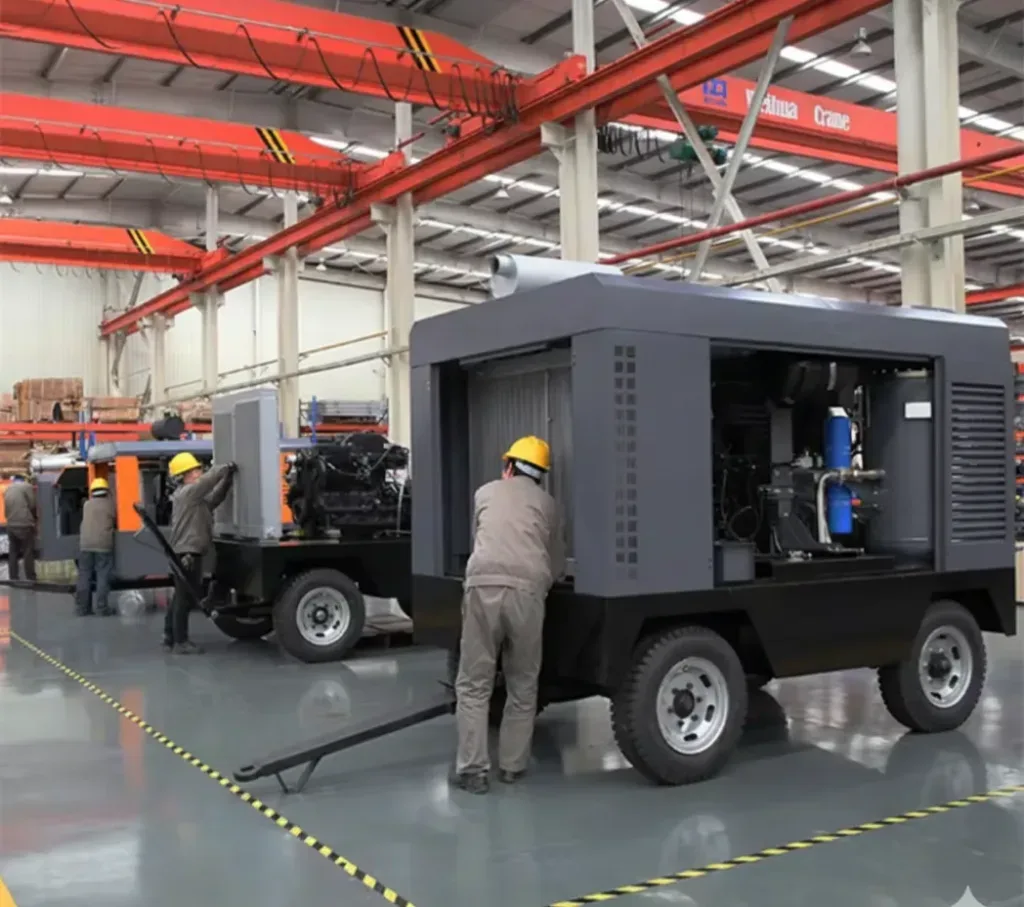
A rotary screw compressor is a positive-displacement machine. Two closely matched helical rotors rotate inside the air end, trapping incoming air and reducing its available volume as it moves toward the discharge side.
Because each rotation displaces a relatively predictable quantity of air, screw compressors are commonly described as constant-volume machines. Flow can be adjusted through loading and unloading, inlet modulation, variable displacement, or motor-speed control.
Rotary screw compressors are available in several configurations:
- Oil-injected fixed-speed
- Oil-injected variable-speed
- Oil-free two-stage screw
- Water-injected screw
- Single-compressor packages or multi-compressor stations
The U.S. Department of Energy describes rotary screw compressors as industrial “workhorse” machines because of their compact construction, continuous operation, relatively simple installation, and broad application range.
For a factory, the main practical advantage is flexibility. Different compressor sizes can be staged according to demand, while a VSD screw compressor can act as a trim unit and adjust output as the plant load changes.
What Is a Centrifugal Air Compressor?
A centrifugal compressor is a dynamic compressor. Instead of trapping and reducing a fixed volume of air, it uses a rapidly rotating impeller to increase air velocity.
The diffuser and other downstream passages then convert part of that velocity energy into pressure. Industrial machines usually use several compression stages with intercooling between stages.
Centrifugal air compressors are commonly installed in:
- Steel and metal production
- Electronics manufacturing
- Automotive plants
- Food and beverage facilities
- Pharmaceutical production
- Chemical and petrochemical plants
- Air-separation systems
- Large general-manufacturing facilities
Centrifugal compressors are designed for large continuous flow. Industrial packages are normally oil-free in the compression stages because lubricant does not enter the air path.
The technology can provide excellent full-load efficiency, but its operating behaviour is closely connected to inlet-air density, cooling-water temperature, system pressure, impeller design, and the compressor’s aerodynamic operating map.
Centrifugal vs Rotary Screw Compressor Comparison
| Selection factor | Centrifugal compressor | Rotary screw compressor |
|---|---|---|
| Compression principle | Dynamic compression using impellers and diffusers | Positive displacement using meshing rotors |
| Best demand pattern | High, stable base load | Variable, intermittent, or staged demand |
| Typical flow direction | Large continuous factory airflow | Small to large modular airflow |
| Turndown | Limited by surge and choke boundaries | Generally wider, especially with VSD |
| Air quality | Compression process is normally oil-free | Oil-injected or oil-free versions available |
| Full-load efficiency | Often strong near the design point | Strong across a broader operating range when correctly controlled |
| Part-load behaviour | Can require inlet throttling or blow-off below stable flow | VSD models can reduce speed to follow demand |
| Sensitivity to inlet conditions | Comparatively high | Usually lower for oil-injected screw machines |
| Cooling | Frequently water-cooled in large sizes | Air-cooled or water-cooled |
| Installation | Requires detailed inlet, cooling, foundation and control planning | Usually easier to package and install |
| Maintenance emphasis | Impellers, bearings, seals, gears, vibration and coolers | Lubricant, separator, filters, air end, drive and coolers |
| Expansion strategy | Add large blocks of capacity | Add modular compressor packages |
| Best system role | Base-load compressor | Base-load, trim, standby or local supply |
This table describes common tendencies, not fixed rules. Modern centrifugal compressors may offer improved turndown, while large oil-free screw compressors can serve major plant loads. The final decision must be based on verified performance data.
The Load Profile Is More Important Than Peak CFM
A factory may report a peak demand of 10,000 CFM, but that number alone is not enough for compressor selection.
The system may use:
- 9,000–10,000 CFM almost continuously
- 4,000 CFM at night and 10,000 CFM during the day
- 2,000 CFM most of the time, with brief 10,000 CFM peaks
- Different flows depending on production schedule
- Large short-duration events from autoclaves, dust collectors or pneumatic conveying
These systems have the same stated peak demand but require very different compressor configurations.
Atlas Copco’s technical guidance states that fluctuating demand usually benefits from the wider turndown of a VSD oil-free screw compressor, while centrifugal units are generally a better fit for steadier flow. It also identifies a common hybrid arrangement: centrifugal for base load and a VSD screw compressor for fluctuating top load.
Before requesting quotations, the factory should conduct a compressed-air audit that records:
- Airflow at short intervals
- System pressure
- Compressor power
- Loaded, unloaded and blow-off status
- Shift and production schedules
- Major end-use events
- Ambient and cooling-water conditions
A one-day measurement may not capture weekly production cycles, maintenance shifts or seasonal effects. Large projects often require at least one representative production week, and sometimes a longer monitoring period.
When a Centrifugal Compressor Is Usually the Better Choice
A centrifugal compressor becomes attractive when the plant has a large block of demand that remains relatively stable for most operating hours.
Stable 24-Hour Base Load
Continuous-process plants may operate near the same airflow for long periods. When a centrifugal compressor can remain close to its design point, it can deliver large volumes efficiently without the lubricant separation system used by an oil-injected screw compressor.
Typical examples include large steel mills, chemical plants, electronics facilities and air-separation operations.
Large Oil-Free Air Requirement
Centrifugal compressors keep lubricant outside the compression path. This can reduce the risk of compressor-originated oil entering sensitive process air.
However, “oil-free compressor” does not mean the complete plant-air system automatically meets every air-quality requirement. Atmospheric hydrocarbons, dirty piping, cooling water leaks, dryer performance and downstream contamination still need to be controlled.
Factories should specify the required particle, water and oil classes at each point of use rather than simply asking for an “oil-free compressor.”
High Continuous Flow From One Central Station
One centrifugal package may replace several smaller compressors when the plant has a sufficiently large, stable demand.
This can reduce the number of main machines, simplify sequencing, and provide a compact amount of installed capacity. The practical benefit depends on redundancy planning and whether the remaining compressors can support production during maintenance.
Strong Cooling-Water Infrastructure
Large centrifugal compressors frequently depend on stable cooling-water temperature, pressure, flow and quality.
A plant with a reliable cooling tower or closed-loop water system may be well suited to this technology. A site with unstable cooling water, fouled exchangers or limited water treatment must include those risks in the selection process.
When a Rotary Screw Compressor Is Usually the Better Choice
Rotary screw technology is often preferred when operational flexibility is more important than maximum efficiency at one design point.
Demand Changes Between Shifts
Factories with large day-to-night differences may not keep a centrifugal compressor inside its efficient operating range.
A VSD screw compressor can adjust motor speed according to demand, while multiple fixed-speed screw machines can be sequenced in capacity steps.
Production Lines Start and Stop Frequently
Automotive assembly, packaging, general manufacturing and batch production can create frequent changes in compressed-air demand.
Modular screw compressors allow the controller to stop unnecessary machines instead of keeping one oversized unit running below its preferred load.
The Plant Is Expanding in Stages
A factory that expects to grow from 2,000 to 8,000 CFM over several years may prefer to add screw compressors as production increases.
This avoids installing a large centrifugal compressor that spends its early years operating well below its intended load.
Air-Cooled Equipment Is Preferred
Water-cooled screw compressors are available, but many stationary screw packages can be air-cooled.
This may reduce dependence on cooling towers and water-treatment equipment, although the compressor room must still remove the heat rejected by the machines.
Local or Decentralised Air Is Needed
Some factories cannot efficiently serve every building from one compressor room. Long piping runs, multiple pressure levels or isolated production areas may make decentralised screw compressors practical.
Before choosing decentralised equipment, the plant should compare pressure loss, maintenance staffing, heat recovery, control complexity and redundancy.
Understanding Centrifugal Turndown, Surge and Choke
A centrifugal compressor cannot reduce flow indefinitely while maintaining the same discharge pressure.
At low flow, the compressor approaches surge. Surge is an unstable condition that may involve pressure oscillation and temporary reverse flow. Repeated or severe surge can create high vibration and mechanical stress.
At excessive flow, the machine approaches choke, where passages reach their aerodynamic flow limit and the compressor can no longer increase flow normally.
The stable operating region lies between these boundaries. Inlet guide vanes, variable inlet control, load-sharing controls and blow-off valves are used to keep the compressor inside this range. DOE guidance specifically identifies surge and choke as operating conditions that centrifugal control systems must avoid.
When demand falls below the stable turndown range, the controller may open the blow-off valve and release compressed air to atmosphere. This protects the machine but wastes the energy used to compress that air.
The purchasing team should therefore request:
- Maximum flow at rated pressure
- Minimum stable flow at rated pressure
- Turndown before blow-off
- Power at minimum stable flow
- Blow-off power consumption
- Performance under summer inlet and cooling-water conditions
Do not compare two centrifugal compressors only at their design point. A machine with excellent full-load specific power may be more expensive to operate when the factory spends many hours below its minimum stable flow.
Understanding Screw Compressor Part-Load Control
Fixed-speed rotary screw compressors may use load/unload control. When system pressure falls, the compressor loads and produces full airflow. When pressure rises, it unloads.
An unloaded compressor still consumes power. If the receiver volume is too small or the pressure band is poorly configured, the machine may cycle rapidly and spend excessive time unloaded.
Inlet modulation can reduce flow without completely unloading, but it may deliver poor part-load efficiency.
A VSD screw compressor changes motor speed to match airflow. This generally provides a wider efficient operating range, although efficiency still falls at very low speed and the machine must be selected so that typical demand remains inside its useful range.
A VSD compressor should not automatically be sized for the entire plant peak. A better configuration may use fixed-speed or centrifugal base-load machines with one properly sized VSD trim compressor.
Why a Hybrid Centrifugal-and-Screw System Often Works Best
Large plants do not always need to choose one technology exclusively.
A hybrid compressor station may use:
- One or more centrifugal compressors for stable base demand
- One VSD screw compressor for changing trim demand
- A smaller compressor for nights, weekends or maintenance shifts
- Storage and a pressure/flow controller for brief peaks
- A master controller to select the most efficient combination
For example, a factory with demand varying between 6,000 and 10,000 CFM might allow a centrifugal compressor to supply a stable 6,000-CFM base load. A VSD screw compressor would then supply the remaining 0–4,000 CFM.
This arrangement avoids asking the centrifugal unit to operate below its stable range and avoids operating a large screw compressor at full speed continuously when a centrifugal machine may be more efficient at base load.
An Ingersoll Rand analysis of large systems exceeding approximately 100 m³/min compared multiple centrifugal, screw and mixed configurations across different demand profiles. Its central lesson was that no single technology is automatically the most efficient; compressor size, control logic, turndown and time spent at each flow determine annual energy use.
How to Compare Energy Efficiency Correctly
Motor efficiency or compressor horsepower does not tell the buyer how efficiently the package produces air.
The most useful performance measures include:
- Delivered airflow at the stated pressure
- Package input power
- Specific power
- Isentropic efficiency where applicable
- Full-load efficiency
- Part-load performance
- Unloaded or blow-off power
- Pressure drop through integrated treatment equipment
CAGI publishes standard data-sheet formats so buyers can compare compressor performance on a more consistent basis. Its guidance notes that specific power expresses the electrical input required to produce a stated airflow at a defined pressure, while isentropic efficiency helps compare machines with slightly different operating pressures.
Comparisons must use equivalent conditions.
A compressor rated at 7 bar should not be compared directly with another rated at 8.5 bar without correcting for the different work required. The evaluation should also include inlet temperature, humidity, cooling-water temperature, dryer pressure drop and site elevation.
The best machine at full load may not produce the lowest annual energy bill. Annual cost depends on how long the compressor operates at each point on its performance curve.
How Inlet Temperature Affects the Decision
Centrifugal compressor capacity is strongly influenced by inlet-air density.
Cool air is denser, allowing the compressor to handle greater mass flow. Hot air is less dense, which can reduce mass-flow and pressure capability.
DOE guidance notes that this inlet-temperature effect is particularly significant for centrifugal compressors and less pronounced for lubricant-injected rotary screw machines because the incoming air mixes with hot lubricant.
This means a centrifugal compressor selected from mild-condition data may not provide the expected summer capacity in a hot compressor room.
The RFQ should include:
- Maximum and minimum ambient temperature
- Inlet-air source and duct length
- Elevation
- Relative humidity
- Cooling-water inlet temperature
- Cooling-water fouling allowance
- Seasonal capacity requirement
The quotation should state whether flow is referenced to standard, normal, actual or free-air conditions.
Air Quality: Oil-Free Does Not End the Discussion
Both oil-free rotary screw and centrifugal compressors can support sensitive factory applications.
The correct selection depends on:
- Required ISO 8573-1 air-quality class
- Whether air contacts products or packaging
- Pressure dew point
- Particle filtration
- Oil aerosol and oil-vapour limits
- Risk of contamination from intake air
- Existing piping cleanliness
- Dryer technology
- Condensate handling
A food, pharmaceutical or electronics plant may require oil-free compression, but it also needs suitable drying, filtration, monitoring and distribution.
A general assembly plant may use oil-injected screw compressors with separators and downstream treatment where the process risk assessment permits it.
Do not apply one air-quality specification to the entire factory without examining each end use. Instrument air, direct-product-contact air, pneumatic cylinders and general cleaning may require different treatment levels.
Compressor Controls, Storage and Redundancy
A large compressor station is a coordinated system, not a collection of independent machines.
The master controller should determine:
- Which compressor supplies base load
- Which compressor acts as trim
- When another machine starts
- When a compressor unloads or stops
- How pressure is maintained in a narrow band
- How runtime is balanced
- How maintenance and standby capacity are managed
Receiver storage can absorb short demand spikes and give the controller time to start or load another compressor. Storage should not be used to conceal a continuous capacity shortage, but it can prevent unnecessary compressor starts during short events.
Redundancy should follow production risk.
A critical 24-hour plant may require N+1 capacity, meaning the factory can meet normal demand while its largest compressor is unavailable. Less critical facilities may accept reduced production during major maintenance.
The standby strategy must include dryers, cooling equipment, filters, electrical supply and controls—not just an extra compressor.
Maintenance Differences
Rotary screw and centrifugal compressors require different maintenance skills.
Rotary Screw Compressor Maintenance
Oil-injected screw machines typically require attention to:
- Compressor lubricant
- Oil filters
- Air/lubricant separator elements
- Intake filters
- Coolers
- Drive couplings or belts
- Minimum-pressure and control valves
- Air-end condition
Oil-free screw compressors may add timing gears, stage seals, specialised rotor coatings and more complex interstage cooling.
Centrifugal Compressor Maintenance
Centrifugal machines typically require attention to:
- Impellers and diffusers
- High-speed bearings
- Gearbox and lubrication system
- Shaft seals
- Vibration
- Intercoolers and aftercoolers
- Inlet guide vanes
- Blow-off and anti-surge controls
- Cooling-water quality
- Motor and electrical protection
Condition monitoring is particularly valuable for centrifugal equipment. Vibration, bearing temperature, stage pressure, cooling-water temperature and approach temperatures can reveal deterioration before a major failure.
DOE documented a brewery where neglected centrifugal compressor maintenance allowed impellers to rub against their shrouds, reduced delivered airflow and contributed to repeated motor failures. The same plant also suffered moisture-control and energy problems because condensate equipment was not maintained correctly.
Technology selection does not replace maintenance discipline.
Total Cost of Ownership
The lowest purchase price rarely identifies the lowest-cost factory-air solution.
A realistic TCO analysis should include:
- Compressor purchase and installation
- Electrical infrastructure
- Cooling-water or ventilation equipment
- Dryers, filters and receivers
- Piping and pressure controls
- Annual energy consumption
- Scheduled maintenance
- Major overhaul costs
- Spare-parts availability
- Production losses during downtime
- Redundancy equipment
- Expected expansion
Energy often dominates the lifecycle cost of a continuously operated compressor, but maintenance and downtime can become equally important in process-critical plants.
The calculation should compare complete systems over a defined period, such as 10 or 15 years. It should not compare one centrifugal machine with one screw machine while ignoring the number of units, controls, storage, dryers and standby capacity required.
Factory Case Lessons
U.S. Steel: Stable Large Demand Favoured Centrifugal Compressors
The U.S. Steel Edgar Thomson plant previously operated six ageing 400-hp oil-cooled rotary screw compressors. The units leaked oil, required frequent repairs and could no longer deliver their rated airflow and pressure.
The plant replaced the main units with two centrally located 600-hp centrifugal compressors. However, the project also replaced dryers and filters, repaired leaks, eliminated inappropriate uses and reduced discharge pressure.
The complete project cost approximately $521,000 and produced reported annual savings of $457,000, including $140,000 in energy and $317,000 in lubricant, repair and maintenance savings. The reported simple payback was 13.5 months.
The lesson is not simply that centrifugal compressors are always better than screw compressors. The replaced screw machines were old and in poor condition. The major result came from combining new equipment with lower pressure, cleaner treatment equipment and a system-level improvement strategy.
Boeing Canada: Variable Autoclave Demand Favoured Screw Compressors and Storage
Boeing Canada Winnipeg used large autoclaves that required substantial but irregular compressed-air flow. Its existing centrifugal system was reported to be inefficient for this demand pattern.
The replacement system used four rotary screw compressors, including two 225-hp VSD units and two 100-hp base-load units. Two 50-hp boosters supplied high-pressure air, while outdoor storage supported autoclave filling.
The station was designed for 100% redundancy, narrow pressure control and minimal piping losses.
This case demonstrates that large flow does not automatically require centrifugal technology. When demand consists of major short-duration events, modular screw compressors, storage and boosters may provide better control.
Electronics Plant: Centrifugal Base Load Plus VSD Screw Trim
An Atlas Copco customer case from an electronics plant in Malaysia reports energy savings exceeding 20% after older compressors were replaced.
The plant initially installed two centrifugal compressors and later added additional centrifugal capacity together with a VSD screw compressor.
As a manufacturer-reported case, the result should not be treated as a universal guarantee. Its value is in the system arrangement: large oil-free centrifugal capacity served the stable production load, while VSD screw technology added flexibility.
A Practical Selection Workflow
Step 1: Measure the Demand
Record airflow, pressure and power over representative production periods. Separate continuous base demand from short peaks.
Step 2: Define the Minimum Pressure
Identify the lowest pressure that satisfies the most demanding end use after dryer, filter and piping losses.
Step 3: Specify Air Quality
Define particle, water and oil classes at the points of use. Determine whether oil-free compression is required or whether treated air from an oil-injected machine is acceptable.
Step 4: Divide Base and Trim Load
Determine how much airflow remains stable and how much changes. This establishes whether centrifugal, fixed-speed screw, VSD screw or a mixed system is appropriate.
Step 5: Compare Complete Performance Curves
Request full-load, part-load, minimum-flow, unloaded and blow-off performance—not only one nameplate point.
Step 6: Design Controls and Storage
Select the sequence controller, receiver capacity, pressure/flow control, standby logic and emergency operating strategy.
Step 7: Calculate Lifecycle Cost
Compare annual power, cooling, maintenance, overhaul, downtime and expansion costs over the expected service life.
Factories evaluating several pressure and capacity classes can also use the Peakroc® compressor selection tool as an initial reference before final engineering review.
Information to Include in an RFQ
| Required information | Why it matters |
|---|---|
| Average, minimum and maximum airflow | Defines base, trim and peak capacity |
| Flow profile by time | Shows how long the plant operates at each load |
| Required point-of-use pressure | Prevents unnecessary system pressure |
| Existing compressor performance | Provides an energy and reliability baseline |
| Air-quality classes | Determines oil-free technology, dryer and filtration |
| Ambient temperature and elevation | Affects compressor capacity |
| Cooling-water conditions | Critical for water-cooled equipment |
| Operating hours per year | Converts specific power into annual cost |
| Electricity tariff and demand charges | Supports accurate TCO |
| Required redundancy | Determines installed standby capacity |
| Expansion forecast | Prevents premature undersizing |
| Available compressor-room space | Affects layout, ventilation and maintenance access |
| Service capability | Influences downtime and lifecycle risk |
Common Selection Mistakes
- Selecting centrifugal equipment only because the plant has a high peak CFM
- Selecting one oversized VSD screw compressor without checking its normal operating range
- Comparing rated horsepower instead of verified flow and input power
- Ignoring summer inlet and cooling-water conditions
- Treating Class 0 or oil-free compression as the complete air-quality specification
- Failing to budget for pressure drop through dryers, filters and piping
- Installing several compressors without a master controller
- Ignoring blow-off, unloaded power and low-load operating hours
- Providing compressor redundancy but no dryer or cooling redundancy
- Buying extra compressor capacity instead of repairing leaks and inappropriate uses
Final Recommendation
Choose a centrifugal compressor when the factory has a large, continuous and predictable base-load demand, suitable cooling infrastructure, and a strong requirement for oil-free air.
Choose rotary screw compressors when airflow changes significantly, production expands in stages, air-cooled equipment is preferred, or the plant needs modular capacity and wide turndown.
For many large industrial systems, the most effective solution is a hybrid arrangement:
Centrifugal compressor for stable base load + VSD rotary screw compressor for trim demand + correctly sized storage + master control.
Do not make the final decision from a catalogue comparison alone. Measure the demand, define the point-of-use pressure, specify air quality, model annual energy use, and compare the complete lifecycle cost of each proposed system.
The best compressor is not simply the machine with the lowest specific power at full load. It is the system that supplies the required air quality and pressure across the complete production cycle with the lowest practical energy, maintenance and downtime cost.
FAQ
Is a centrifugal compressor more efficient than a screw compressor?
A centrifugal compressor can be highly efficient near its design point when supplying large, stable airflow. A screw compressor may be more efficient for a plant with variable demand because it can operate over a wider flow range without centrifugal blow-off.
At what airflow should a factory consider a centrifugal compressor?
There is no universal CFM threshold. Centrifugal technology becomes more attractive as stable base-load demand increases, but the decision depends on flow profile, pressure, air quality, cooling, turndown and annual operating hours.
Can a centrifugal compressor handle changing demand?
It can regulate flow within its stable operating range using inlet guide vanes and other controls. Below its minimum stable flow, it may need to blow off air. Plants with wide demand changes often pair a centrifugal base-load machine with a VSD screw trim compressor.
What is surge in a centrifugal compressor?
Surge is an unstable low-flow condition that may cause pressure oscillation and temporary flow reversal. Anti-surge controls and blow-off valves protect the compressor from operating in this region.
Which compressor is better for oil-free factory air?
Both oil-free screw and centrifugal compressors can supply air without lubricant entering the compression chamber. The better choice depends on airflow, load variation, pressure, efficiency, maintenance and required air quality.
Is a VSD screw compressor always the most efficient option?
No. A VSD compressor is valuable when demand varies and the unit operates within an efficient speed range. A fixed-speed or centrifugal compressor may be more efficient for a stable base load.
Can a large factory use centrifugal and screw compressors together?
Yes. This is a common and effective arrangement. The centrifugal compressor supplies stable base demand, while the screw compressor adjusts output to follow production changes.
What data should be collected before selecting a large factory compressor?
Collect airflow, pressure, power, loaded and unloaded status, shift patterns, end-use events, air-quality requirements, ambient conditions, cooling-water data, annual hours and expected expansion.
Author

Mark Chen – Senior Mechanical Engineer, Peakroc®
Mark Chen is a senior mechanical engineer at Peakroc®, specializing in compressed air systems and drilling equipment for mining and construction applications. With over 15 years of field experience, he has led multiple projects on optimizing air delivery efficiency, equipment durability, and energy consumption.