
Key Takeaways
- Start with the laser inlet requirement, not compressor motor kW. Obtain required assist-gas pressure and consumption for the actual nozzle, material, thickness, and cutting recipe.
- 16 bar is about 232 PSI and 20 bar is about 290 PSI, but higher pressure is useful only when the cutting process can actually use it.
- Select the compressor by FAD at the required pressure and include dryer, filter, regulator, and piping pressure losses in the calculation.
- Specify compressed-air quality in measurable terms. ISO 8573-1 classifies compressed-air purity by particles, water, and oil rather than vague descriptions such as “clean air.”
- Compressed air can reduce dependence on purchased assist gas in suitable applications, but cut quality depends strongly on material, nozzle design, pressure, speed, focus, and downstream finishing requirements. Experimental research confirms that assist-gas pressure and gas type materially influence the cutting process.
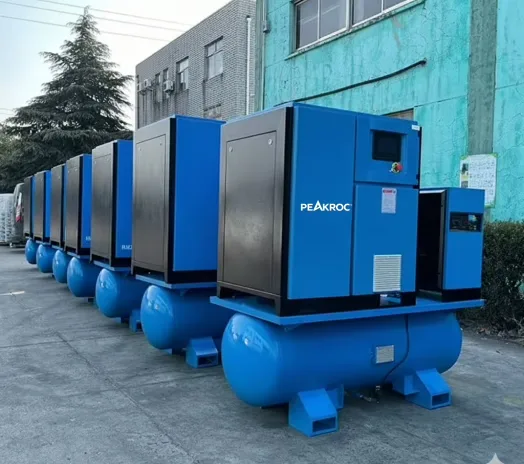
- For an integrated solution, the Peakroc® 16–20 Bar Integrated 4-in-1 Laser Cutting Air Compressor combines the compressor, receiver, refrigerated dryer, and filtration system, with published capacities from 1.05 to 3.9 m³/min.
Why Fiber Laser Cutting Needs a Different Compressed-Air System
A normal workshop compressor may operate pneumatic cylinders, air tools, cleaning guns, or general production equipment at approximately 7–10 bar.
Fiber laser assist air is different.
The air passes through the cutting head and a relatively small nozzle, where it must provide enough momentum to remove molten material from the kerf while maintaining a stable cutting process. Depending on the material, nozzle, sheet thickness, laser power, and process settings, considerably higher pressure may be required.
Research into fiber laser cutting confirms that assist gas is not a secondary parameter. Pressure influences melt removal and cut quality, while the optimum value changes with the cutting configuration. In one experimental study on 10 mm stainless steel and 4 mm aluminum using a 5 kW fiber laser, assist-gas pressure significantly influenced cut behaviour; importantly, increasing pressure beyond approximately 16 bar did not continue producing a significant surface-roughness improvement under that particular test configuration.
That finding highlights an important purchasing principle:
20 bar is not automatically better than 16 bar.
The correct pressure is the one that supports the required cutting recipe after all treatment and distribution losses have been included.
Start With the Cutting Recipe, Not Laser kW
A common shortcut is to match compressor motor power directly to laser power.
For example, preliminary sizing charts sometimes associate lower-power lasers with approximately 15 kW compressors, medium systems with approximately 22 kW, and larger lasers with approximately 37 kW compressor packages.
That can be useful for generating a shortlist, but it is not a reliable final selection method.
Two 6 kW fiber lasers can have different compressed-air demand if they use different nozzle diameters, materials, sheet thicknesses, cutting heads, or pressure settings.
Before requesting a compressor quotation, collect these six values:
- Fiber laser power and cutting-head specification
- Material: mild steel, stainless steel, or aluminum
- Maximum thickness to be cut with compressed air
- Nozzle diameter and cutting recipe
- Required assist-air pressure at the laser inlet
- Maximum air consumption at that pressure
Peer-reviewed experiments support this approach. Cutting speed, focal position, assist-gas pressure, nozzle behaviour, and material all interact; laser power alone cannot describe the complete cutting condition.
16 Bar vs 20 Bar: Think in Terms of Pressure at the Laser
The compressor discharge pressure is not necessarily the pressure arriving at the cutting machine.
Air may first pass through a receiver, dryer, moisture separator, multiple filters, piping, flexible hose, regulator, and valves. Every restriction produces some pressure loss.
A practical pressure budget is:
Required compressor discharge pressure = required laser inlet pressure + air-treatment pressure drop + piping pressure drop + reasonable regulation allowance
Suppose a cutting recipe needs close to 16 bar at the laser inlet. Selecting a compressor with a maximum discharge pressure of exactly 16 bar leaves very little allowance for treatment and distribution.
In that situation, a 20 bar package may be justified even though the laser itself does not continuously require 20 bar.
By contrast, if validated production recipes operate comfortably below the available pressure from a 16 bar system, generating 20 bar continuously may add equipment and energy cost without improving production.
Research also shows why there is no universal “best pressure.” A recent experimental air-assisted fiber laser study achieved substantial cut-quality improvements through nozzle-flow optimisation, demonstrating that stable gas-jet behaviour can matter as much as simply increasing supply pressure.
Size FAD at Pressure, Not Just Compressor Power
Pressure answers one question:
Can the compressor reach the required pressure?
FAD answers another:
Can it continuously supply enough air while maintaining that pressure?
A laser-cutting compressor that reaches 20 bar but cannot supply sufficient FAD may experience pressure decay as soon as the assist-gas valve opens.
Peakroc’s current PRMEL range illustrates how different airflow capacities can exist within the same pressure class.
| Model example | FAD | Working pressure | Motor power | Receiver |
|---|---|---|---|---|
| PRMEL-15 | 1.05 m³/min | 16 bar | 11 kW | 400 L |
| PRMEL-20 | 1.52 m³/min | 16 bar | 15 kW | 400 L |
| PRMEL-30 | 2.41 m³/min | 16 bar | 22 kW | 400 L |
| PRMEL-50P | 3.90 m³/min | 16 bar | 37 kW | 600 L |
| PRMEL-15P | 1.05 m³/min | 20 bar | 11 kW | 400 L |
| PRMEL-30P | 2.41 m³/min | 20 bar | 22 kW | 400 L |
| PRMEL-50PP | 3.90 m³/min | 20 bar | 37 kW | 600 L |
These figures are product operating points, not universal recommendations for corresponding laser powers.
The final selection should use the cutting machine’s actual maximum assist-air consumption.
If two laser machines may operate simultaneously, their realistic simultaneous demand must be considered together.
Why the Air Receiver Is Important
Laser assist-air consumption changes throughout the production cycle.
Piercing, continuous cutting, repositioning, unloading, and a change in material or nozzle can create rapid variations in demand.
The receiver provides a buffer between the compressor and those changes.
It helps stabilise short-duration pressure fluctuations and reduces the need for the compressor control system to react instantly to every change in cutting demand.
Peakroc’s integrated laser systems use 400 L or 600 L receivers depending on model.
However, a receiver is not a substitute for compressor capacity.
If a laser continuously consumes more air than the compressor produces, the stored air will eventually be depleted and pressure will fall.
The correct sequence is therefore:
Size continuous FAD first → then size storage for pressure stability and demand variation.
Dryer and Dew Point: Why “Dry Air” Is Not Specific Enough
Moisture is one of the most important differences between ordinary workshop air and laser assist air.
Compression concentrates water vapour. As compressed air cools, some of that vapour condenses.
If liquid water or excessive water vapour reaches sensitive downstream equipment, process consistency can suffer. That is why laser cutting systems normally include drying as well as filtration.
A refrigerated dryer may be sufficient where the required pressure dew point and compressor-room conditions allow it. A more demanding installation may require a lower dew point and therefore a different drying technology.
The purchase specification should not simply say:
“Include an air dryer.”
Instead, ask:
“What pressure dew point is required at the laser inlet under our maximum ambient temperature and airflow?”
The dryer must then be sized at the actual system pressure and flow.
Peakroc’s integrated 4-in-1 laser compressor includes a refrigerated dryer and precision filtration in the same package.
For projects requiring a different dew-point target, the treatment system should be engineered around the laser manufacturer’s specification rather than assuming the integrated refrigerated dryer will meet every possible process requirement.
Filtration and ISO 8573-1 Air Quality
Terms such as “high-purity air,” “oil-free air,” and “very clean air” can be ambiguous unless a measurable specification is attached.
ISO 8573-1 provides a much better framework.
The current published ISO 8573-1:2010 standard classifies compressed-air purity primarily according to:
- Particles
- Water
- Oil
It also identifies additional contaminant categories, but particles, water, and oil are the main purchasing parameters relevant to most laser compressed-air discussions.
This matters because an oil-lubricated screw compressor fitted with downstream oil-removal equipment is not technically the same thing as an inherently oil-free compression chamber.
Therefore, rather than asking:
“Is the compressor oil-free?”
Ask:
“What particle, water, and total-oil limits are guaranteed at the laser inlet?”
The required ISO 8573-1 class should ideally come from the laser equipment specification.
A properly designed treatment package may include the compressor, receiver, dryer, water separation, staged filtration, regulator, and correctly sized piping.
The important measurement point is the air arriving at the cutting machine, not only the compressor outlet.
Compressed Air vs Nitrogen
Compressed air is attractive because it can be generated onsite.
Nitrogen generally has to be purchased, delivered, stored, generated onsite with additional equipment, or supplied from a bulk system.
But they are not chemically equivalent assist gases.
Nitrogen is used as an inert assist gas when oxidation needs to be minimised. Compressed air contains nitrogen plus oxygen, so its interaction with hot metal can change edge colour, oxide formation, heat input, dross, and the suitability of the cut edge for later finishing.
Experimental research comparing oxygen, nitrogen, and compressed air in fiber laser cutting confirms that the choice of assist gas affects surface quality, thermal behaviour, hardness, and post-processing requirements.
A practical comparison is:
| Production objective | Compressed air | Nitrogen |
|---|---|---|
| Reduce purchased assist-gas cost | Strong potential | Usually higher gas supply cost |
| Aluminum cutting | Can be attractive after process validation | Suitable where recipe specifies inert gas |
| Stainless steel cosmetic edge | Must evaluate oxidation | Often preferred where oxidation must be minimized |
| Mild steel | Can suit selected recipes | Useful where oxide-free edge is required |
| Parts requiring later coating/welding | Test edge condition first | Often easier where oxidation must be minimized |
| Highest consistency across validated inert-gas recipes | Process dependent | Established option |
The correct economic comparison is therefore not simply air price vs nitrogen price.
It should include cutting speed, edge quality, gas consumption, compressor electricity, dryer and filter maintenance, nitrogen cost, scrap, and any additional edge preparation.
Material Matters: Mild Steel, Stainless Steel, and Aluminum
Mild Steel
Oxygen-assisted cutting has a different mechanism because oxidation contributes additional heat to the process. Research on mild steel confirms that gas type and pressure significantly affect piercing and cutting behaviour.
Compressed air may work well for selected mild-steel jobs, but some oxidation at the edge should be expected because air contains oxygen.
Whether that matters depends on what happens next.
A structural part going directly to assembly may tolerate a different edge condition from a decorative component or a part requiring high-quality powder coating.
Stainless Steel
Stainless steel places greater emphasis on edge oxidation when cosmetic appearance, corrosion behaviour, welding, or coating is important.
Nitrogen is commonly used for inert cutting, but compressed-air processing is increasingly technically feasible where the resulting edge meets the production requirement.
A recent experimental study on AISI 304 demonstrated effective air-assisted fiber laser cutting and showed that improving nozzle jet behaviour substantially reduced dross, kerf width, taper, and roughness.
The key lesson is that the result depends on the complete process, not merely the compressor pressure.
Aluminum
Fiber laser studies on aluminum show that assist-gas pressure is one of the variables affecting melt removal and surface quality.
Compressed air can therefore be attractive in suitable aluminum production, particularly where lower purchased-gas cost matters more than reproducing a specific inert-gas edge.
Again, sample cutting is preferable to assuming one published material thickness will transfer directly to another machine.
Where VSD Can Help
Laser cutting often creates variable compressed-air demand rather than one perfectly constant load.
A Variable Speed Drive compressor can adjust motor speed as demand changes. That can improve pressure control and reduce unnecessary full-speed operation when the production cycle contains substantial partial-load periods.
Peakroc’s VSD compressor selection guide explains the broader relationship between variable demand and VSD operation.
However, VSD does not correct undersizing.
A variable-speed compressor still has a maximum FAD at its rated pressure. If the laser requires more air than that capacity, pressure will fall regardless of drive technology.
VSD makes the strongest case when air demand genuinely varies over time.
A Better Way to Compare Operating Cost
The business case for compressed air should be calculated per production output rather than simply comparing electricity price with the price of a nitrogen cylinder.
A useful model is:
Assist-gas cost per part = compressor electricity + dryer/filter maintenance + compressor service + allocated capital cost + any supplemental gas + edge post-processing ÷ accepted parts produced
The comparison should also include cutting speed.
A process that saves assist-gas cost but slows cutting substantially, causes additional dross removal, or increases rejected parts may not deliver the lowest total cost.
Conversely, a properly engineered compressed-air process can become economically attractive when the cut quality remains acceptable and purchased-gas consumption falls substantially.
Common Sizing Mistakes
Avoid these six mistakes:
- Selecting compressor kW directly from fiber laser kW.
- Buying 20 bar simply because it is higher than 16 bar.
- Comparing maximum pressure without verifying FAD at that pressure.
- Ignoring pressure loss through dryers, filters, regulators, and piping.
- Treating the receiver tank as a substitute for insufficient continuous FAD.
- Assuming compressed air and nitrogen will produce the same edge on every material and thickness.
The supplied reference page is useful in emphasizing high pressure, drying, filtration, and matching the compressor to the laser, but final engineering should go beyond a laser-kW-to-compressor-kW lookup.
Practical RFQ Checklist
Before requesting a quotation, provide:
- Laser details: laser power, cutting head, and number of machines.
- Material range: mild steel, stainless steel, aluminum, and maximum thickness.
- Cutting parameters: nozzle diameter and recipes intended for compressed air.
- Air demand: required pressure and maximum flow at the laser inlet.
- Air quality: required pressure dew point and ISO 8573-1 purity class.
- Factory conditions: voltage, frequency, ambient temperature, operating hours, piping distance, and future expansion.
The Peakroc® Compressor Finder can then be used to compare pressure, FAD, motor power, and drive type before final selection.
Final Recommendation
A 16–20 bar fiber laser compressor should be treated as an assist-gas production system, not simply as a high-pressure air compressor.
Start with the pressure and airflow required at the cutting machine.
Then calculate the pressure losses between the compressor and laser, select adequate FAD, provide sufficient storage, and specify the required dryer and filtration system.
Use ISO 8573-1 terminology to define air purity rather than relying on general expressions such as “clean,” “dry,” or “oil-free.”
Finally, validate compressed-air cutting on the actual material.
Research consistently shows that assist gas, pressure, nozzle behaviour, focus, cutting speed, material, and thickness interact. No universal 16 bar or 20 bar setting can replace a validated cutting recipe.
The purchasing question should therefore be:
Which combination of pressure, FAD, storage, drying, filtration, and cutting parameters gives us the required edge quality at the lowest reliable cost per accepted part?
That question leads to a much better compressor decision than choosing from laser power or maximum bar alone.
FAQ
Is 16 bar enough for fiber laser cutting?
It can be. The answer depends on the required pressure at the cutting head after dryer, filter, regulator, and piping losses. If the validated process requires pressure close to 16 bar at the laser inlet, a higher-pressure compressor may provide necessary system allowance.
Why use a 20 bar compressor for laser cutting?
A 20 bar compressor can provide additional pressure headroom for processes requiring higher assist-gas pressure or systems with meaningful treatment and piping losses. It should not be selected solely because 20 bar is higher than 16 bar.
How much CFM does a fiber laser need?
There is no universal figure. Use the laser manufacturer’s maximum assist-air consumption at the required pressure and select the compressor according to FAD at that operating point.
Can compressed air replace nitrogen in fiber laser cutting?
In suitable processes, yes. However, compressed air contains oxygen and may produce a different cut edge from inert nitrogen. Material, thickness, edge-quality requirements, cutting speed, and downstream processes should be evaluated before changing assist gas.
What air quality does a fiber laser require?
Use the cutting-equipment specification to define allowable particles, water, and oil. ISO 8573-1 provides the standard framework for expressing these compressed-air purity requirements.
Does laser cutting always need a desiccant dryer?
No. Dryer selection depends on the required pressure dew point and factory conditions. A refrigerated dryer can suit some installations, while a lower dew-point requirement may justify a different drying technology.
Is a larger receiver tank a substitute for a larger compressor?
No. A receiver helps buffer short demand changes, but it cannot supply a continuous airflow deficit. Compressor FAD must still cover sustained laser demand.
Is an integrated compressor, dryer, tank, and filtration package useful?
It can simplify installation and component matching. Peakroc’s integrated 16–20 bar system combines these four functions and offers published capacities from 1.05 to 3.9 m³/min.
Author

Mark Chen – Senior Mechanical Engineer, Peakroc®
Mark Chen is a senior mechanical engineer at Peakroc®, specializing in compressed air systems and drilling equipment for mining and construction applications. With over 15 years of field experience, he has led multiple projects on optimizing air delivery efficiency, equipment durability, and energy consumption.