
Key Takeaways
- 10–15 bar / approximately 145–218 PSI is a useful medium-pressure range for portable compressors, sitting between general construction air and the higher-pressure class used for demanding DTH and deeper boreholes. For the broader relationship between airflow, pressure and application, see the Peakroc Portable Diesel Air Compressor Buyer’s Guide.
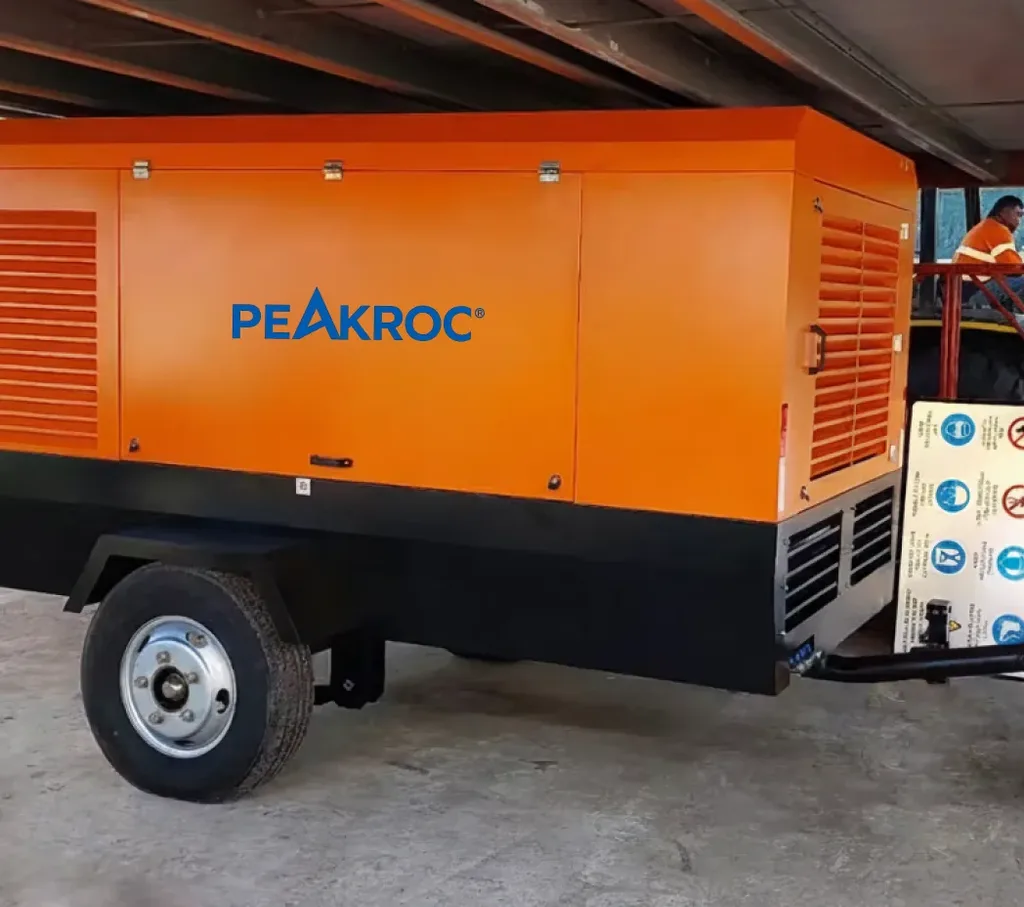
- For moderate airflow requirements, the Peakroc PRMD-1010 10 m³/min, 10 bar Portable Air Compressor is a practical reference for shallow drilling, quarry support, pipeline work and medium-pressure field applications.
- Pressure class does not determine compressor size. The Peakroc PRMD-2712 27 m³/min, 12 bar Portable Air Compressor demonstrates how a medium-pressure machine can still provide very high airflow for mining, drilling, sandblasting and large construction projects.
- For applications requiring more pressure together with substantial airflow, the Peakroc PRMD-2013 20 m³/min, 13 bar Portable Air Compressor is positioned for DTH drilling, blast holes, foundation work, soil nailing and rock anchoring.
- Always select pressure and FAD together. A 10-bar machine with 45 m³/min airflow can support a very different workload from a 13-bar machine with 13 or 20 m³/min. The correct specification is the airflow the application needs at the required working pressure.
Portable air compressors are often compared by pressure because bar and PSI are simple numbers to understand. But the 10–15 bar / 150–220 PSI range is one of the easiest pressure classes to oversimplify.
It sits above ordinary 7–8 bar construction air and below the 18–25 bar class commonly used for more demanding deep-hole and high-pressure DTH work. That makes medium-pressure portable compressors useful across quarry drilling, shallow boreholes, anchoring, sandblasting, pipeline operations and heavier construction.
However, medium pressure is not a compressor size. A 10 m³/min machine at 13 bar and a 27 m³/min machine at 12 bar may sit in a similar pressure range, yet their practical capacity is very different.
The correct selection sequence is:
Application → Pressure Required at the Tool → CFM/FAD → Distribution Losses → Site Conditions → Compressor Size
What Does 10–15 Bar Medium Pressure Actually Mean?
There is no universal international rule stating that every compressor between exactly 10 and 15 bar must be classified as “medium pressure.” Manufacturers define their ranges differently. In portable compressor applications, however, approximately 10–14/15 bar is a useful practical band between standard-pressure construction equipment and higher-pressure drilling machines.
The distinction is mainly operational.
A standard 7–8 bar compressor can be entirely suitable for breakers, pneumatic tools and many general construction jobs. Moving toward 10–15 bar gives additional pressure capability for applications where the air must travel through longer hoses, power a more demanding drilling tool or overcome greater system resistance.
Above this range, compressors in the 18–25 bar class increasingly serve harder-rock DTH drilling, greater borehole depth and higher backpressure.
This does not mean 15 bar is automatically “better” than 10 bar. It means the machine has a different pressure capability.
The objective is to choose enough pressure to satisfy the process while avoiding pressure that the application cannot use.
Pressure and FAD Must Be Selected Together
Two specifications define whether a portable compressor can actually do the work:
Working pressure tells you whether the compressor can maintain the pressure required by the tool or process.
FAD, or Free Air Delivery, tells you how much usable air the machine can continuously supply.
Consider three medium-pressure examples:
| Compressor Class | FAD | Working Pressure | Typical Capacity Direction |
|---|---|---|---|
| 10 m³/min class | 10 m³/min / 375 CFM | 10 bar / 145 PSI | Moderate airflow, medium pressure |
| 27 m³/min class | 27 m³/min / ~950 CFM | 12 bar / 174 PSI | High airflow, medium pressure |
| 20 m³/min class | 20 m³/min / 710 CFM | 13 bar / 189 PSI | Strong airflow with more pressure reserve |
This is why asking:
“Should I choose 10 bar or 13 bar?”
does not provide enough information.
A 27 m³/min compressor at 12 bar supplies far more air than a 10 m³/min compressor at 10 bar, even though their pressure ratings are fairly close. Likewise, a 45 m³/min compressor at 10 bar can support a much larger total air demand than a smaller 13-bar machine.
The useful specification is:
Required FAD at the required working pressure.
For drilling, pressure and airflow also perform different jobs. Pressure supports hammer impact, while airflow keeps the hammer cycling and removes cuttings from the hole. In sandblasting, airflow becomes especially important because the nozzle needs a continuous volume of air while the required pressure may remain relatively moderate.
One cannot replace the other.
How 10, 12, 13 and 15 Bar Fit Different Applications
The difference between 10, 12, 13 and 15 bar should not be treated as four rigid application categories. A job may fit more than one pressure class depending on tool requirements, hose layout and available airflow.
A useful starting framework is:
| Pressure Class | Typical Application Direction | Main Reason to Choose It |
|---|---|---|
| 10 bar / 145 PSI | Quarry support, shallow drilling, heavier construction, pipeline work | More pressure margin than 7–8 bar |
| 12 bar / 174 PSI | High-flow mining, drilling, sandblasting, industrial projects | Combines medium pressure with large airflow |
| 13 bar / 189 PSI | Medium-pressure DTH, anchoring, blast holes, foundation drilling | Additional pressure reserve for drilling and hose loss |
| 14–15 bar / 203–218 PSI | Upper medium-pressure applications | Useful when the tool needs more than 13 bar but not a full high-pressure system |
These are general selection directions rather than fixed design limits.
A drilling tool that genuinely requires 18–20 bar will not become productive simply because a 15-bar compressor is called an upper-medium-pressure machine. At the same time, buying a 20- or 25-bar compressor for a process that only needs 9–10 bar can add cost, weight and fuel consumption without improving production.
The best pressure class is the lowest one that comfortably maintains the required pressure at the point of use.
Quarry Drilling and Shallow Boreholes
Quarrying is one of the most natural applications for medium-pressure compressors. Shallow blast holes and medium-depth boreholes often need more pressure than general pneumatic construction tools, while not always requiring the 20–25 bar associated with deeper DTH work.
For DTH drilling, compressor sizing starts with the hammer. The hammer manufacturer provides a required operating pressure and air consumption. Hole diameter, drilling depth, geology and flushing conditions then determine whether additional airflow or pressure reserve is needed.
A small hammer drilling shallow holes in weathered limestone may work effectively in the 10–13 bar range. A larger hammer drilling deeper holes through hard granite may need a higher pressure class.
The important rule is:
Do not choose the compressor from hole depth alone. Choose it from the hammer, hole diameter, geology and required air consumption.
Medium-pressure compressors work well when the actual drilling system fits their operating envelope.
Sandblasting and Surface Preparation
Sandblasting demonstrates why airflow can matter more than maximum compressor pressure.
A blast nozzle consumes a large volume of air continuously. As nozzle diameter increases, the required CFM rises quickly. The blasting pressure itself may still remain within a relatively moderate range.
That means a high-flow 10- or 12-bar compressor can often be more useful than a smaller machine capable of higher pressure.
A good sandblasting selection sequence is:
Nozzle Diameter → Required Nozzle CFM → Required Nozzle Pressure → Hose Loss → Compressor FAD
Long blast hoses, moisture separators, aftercoolers and fittings can all create pressure loss. The compressor may therefore need some additional discharge-pressure margin, but the purpose of that margin is to maintain the required nozzle pressure—not to operate the nozzle at the compressor’s maximum pressure.
For large shipyard, steel fabrication or multi-nozzle work, total airflow usually becomes the first capacity question.
Pipeline Testing, Purging and Commissioning
Pipeline applications can also fall into the medium-pressure range, but “pipeline compressor” can mean several different duties.
Compressed air may be used for:
- pipeline purging and cleaning;
- drying support;
- leak testing where pneumatic testing is approved;
- valve and actuator work;
- commissioning operations.
The compressor must be selected from the actual engineering procedure.
For a large-diameter pipeline, airflow may determine how quickly the line can be purged or pressurized. For a pressure test, the approved test pressure and procedure become more important than the compressor’s maximum rating.
A compressor capable of 13 or 15 bar does not mean that every pipeline should be tested at that pressure.
The system design, applicable standard and approved test procedure determine the allowable test pressure.
From the compressor side, the useful parameters are:
required pressure + pipeline volume + required fill time + flow demand
Medium-pressure, high-flow compressors can be attractive where the procedure requires both substantial air volume and more pressure than a standard 7–8 bar unit can provide.
Anchoring, Soil Nailing and Foundation Construction
Ground-engineering work often sits naturally in the medium-pressure category.
Some soil-nailing and foundation projects use rotary drilling and need compressed air mainly for flushing. Other rock-anchor and micropile projects use DTH drilling, which places greater demand on both pressure and airflow.
This is why the application name alone is not enough.
Two projects may both be described as “rock anchoring,” yet one may involve short holes in weathered ground while another requires larger DTH holes in competent rock.
For these applications, compressor sizing should follow:
Drilling Method → Hammer or Tool → Hole Diameter → Depth → Geology → Air Demand
A 13-bar machine can provide useful pressure reserve for medium-pressure DTH and long hose runs, but harder formations or deeper drilling may justify moving into the 20-bar class.
Medium pressure is useful when it matches the drilling tool—not simply because the project is called anchoring or micropiling.
Hose Loss and Point-of-Use Pressure
The compressor rating is measured at or near the machine. The tool may be tens of meters away.
Between those two points are hoses, couplings, filters, valves, manifolds and sometimes air-treatment equipment. Every restriction creates pressure loss.
This is particularly important for high-flow medium-pressure systems. Moving 20 or 30 m³/min through an undersized hose can create a significant drop even though the compressor itself is working correctly.
That can lead to a common troubleshooting mistake:
The tool performs poorly, so the contractor assumes the compressor needs more pressure.
Sometimes the better solution is a larger hose.
When evaluating a medium-pressure compressor, check:
- hose internal diameter;
- total hose length;
- number of couplings and valves;
- simultaneous air users;
- pressure at the actual tool under load.
The number on the compressor gauge matters less than the pressure and airflow available where the work occurs.
Site Conditions Can Change Real Performance
Catalogue ratings are only one part of field performance.
Portable compressors often operate at remote mine sites, high elevations, dusty quarries or hot construction projects. These conditions affect the diesel engine, cooling system and intake air.
Altitude reduces air density. High temperature increases cooling demand. Dust increases filter loading and can reduce intake performance if maintenance is poor.
A compressor that works comfortably at sea level may have less operating margin at a high-altitude mine.
For difficult sites, machine selection should therefore include:
- project altitude;
- expected maximum ambient temperature;
- dust level;
- daily operating hours;
- required continuous load;
- maintenance access.
Adding pressure alone does not solve environmental derating. The engine, cooling package, filtration and airflow capacity all need to suit the jobsite.
Field Case: Why 10 Bar Can Still Mean Very High Capacity
A Peakroc mining project in Western Australia provides a useful example of why pressure class should not be confused with compressor capacity.
The contractor operated four blasthole drilling rigs at an open-pit iron ore site. Previously, the operation used three 15 m³/min compressors running together.
The replacement system used one 45 m³/min compressor at 10 bar.
The pressure rating remained in the medium-pressure range, but the available airflow was large enough to centralize the air supply for several rigs. According to the documented project results, the change simplified fuel supply and service scheduling while improving overall air availability.
The technical lesson is more important than the machine size:
10 bar does not mean low output.
A 45 m³/min compressor at 10 bar is a high-capacity production machine. A 10 m³/min compressor at the same pressure serves a completely different workload.
Pressure class tells you what pressure is available.
FAD tells you how much work the compressor can support at that pressure.
Field Case: Why 13 Bar Can Provide Useful Drilling Margin
Medium-pressure drilling often requires a balance rather than an extreme value.
Peakroc’s 20 m³/min, 13 bar class provides a useful example. It sits above standard construction pressure while remaining below the dedicated 20–25 bar deep-drilling category.
This type of configuration can suit projects where a DTH hammer needs more pressure than standard construction air, while the borehole depth or geology does not justify a high-pressure two-stage drilling system.
The additional pressure can also provide useful margin across longer hose runs or more demanding drilling conditions, provided the actual tool still falls within the compressor’s airflow and pressure capability.
The key principle is:
Pressure reserve should solve a real drilling requirement.
It should not be added simply because a higher number appears safer.
If the hammer requires 20 bar, a 13-bar compressor is the wrong machine.
If the hammer and system operate comfortably at 10–13 bar, moving unnecessarily to 25 bar may simply add operating cost.
Common Medium-Pressure Selection Mistakes
The most common problems are usually not caused by the compressor itself. They come from matching the wrong pressure or airflow class to the job.
- Choosing bar before CFM/FAD: A compressor can have enough pressure but still be too small for the total air demand.
- Assuming 13 bar is automatically better than 10 bar: Extra pressure has value only when the tool or system needs it.
- Ignoring simultaneous demand: Several pneumatic tools or blast nozzles operating together can multiply the required airflow.
- Ignoring hose loss: A correctly rated compressor can still deliver poor tool pressure through long or undersized hoses.
- Using medium pressure for a genuinely high-pressure DTH job: Hard rock and deeper drilling may require 18–25 bar.
- Oversizing sandblasting pressure: Blasting often needs more airflow rather than very high pressure.
- Ignoring altitude and heat: Engine and cooling-system performance can change significantly in demanding environments.
Practical Buying Checklist
Before requesting a quotation for a 10–15 bar portable compressor, prepare the following information:
- Application: Quarry drilling, borehole drilling, sandblasting, pipeline work, anchoring or construction.
- Required working pressure: Pressure needed by the actual hammer, nozzle, tool or process.
- Required airflow: CFM or m³/min at the required pressure.
- Tool specification: DTH hammer, blast nozzle or pneumatic equipment model.
- Number of simultaneous users: One drill, multiple drills, one nozzle or multiple nozzles.
- Hole diameter and depth: For drilling applications.
- Ground condition: Soil, limestone, sandstone, granite, basalt or mixed formation.
- Hose diameter and length: From compressor outlet to the point of use.
- Altitude: Project elevation above sea level.
- Ambient temperature: Typical and maximum expected temperature.
- Duty cycle: Intermittent work or continuous multi-shift operation.
- Air-treatment requirement: Moisture separation, aftercooling, filtration or drying.
- Mobility: Trailer, skid or integrated package.
- Future demand: Larger tools, additional operators or deeper drilling expected later.
If required airflow is unknown, begin with the tool specification.
If required pressure is unknown, do not copy another contractor’s compressor rating. Identify what the actual tool or engineered process requires.
Final Recommendation
The 10–15 bar / 150–220 PSI range is one of the most versatile pressure categories in portable compressed air.
It can bridge the gap between standard construction equipment and dedicated high-pressure drilling machines, making it useful for quarry drilling, shallow boreholes, anchoring, pipeline work, sandblasting and heavy construction.
But that versatility does not mean one medium-pressure compressor can do everything.
A practical selection process is:
Application → Required Pressure at the Tool → Required FAD → Hose/System Loss → Site Conditions → Compressor Size
Choose 10 bar when the tool needs only moderate pressure and airflow is the greater priority.
Choose 12–13 bar when the application needs more pressure reserve while still requiring substantial airflow.
Consider 14–15 bar only when the actual tool or process benefits from the additional pressure.
And when the drilling system genuinely requires 18–25 bar, move into the appropriate high-pressure class rather than trying to stretch a medium-pressure compressor beyond its intended duty.
The best compressor is not the machine with the highest PSI.
It is:
the compressor that delivers enough airflow at the pressure the application actually requires, with sufficient practical margin for the real jobsite and no unnecessary pressure or capacity.
FAQ
What is considered a medium-pressure portable air compressor?
There is no universal industry boundary, but approximately 10–14/15 bar, or 145–220 PSI, is a practical medium-pressure range for many portable compressor applications.
What is a 10-bar portable compressor used for?
A 10-bar compressor can support quarry work, shallow drilling, pipeline operations, heavier construction and high-airflow field applications when its FAD matches the equipment demand.
Is 13 bar enough for DTH drilling?
It can be suitable for shallow to medium-depth DTH applications when the hammer is designed for that pressure range. Harder rock, larger hammers or deeper drilling may require 18–25 bar.
Is 13 bar better than 10 bar for sandblasting?
Not automatically. Sandblasting often depends more heavily on nozzle airflow. If the required nozzle pressure is already maintained, additional compressor pressure may provide little benefit.
What is more important: CFM or PSI?
Both are essential. PSI or bar must satisfy the pressure requirement, while CFM/FAD must supply the necessary volume of air. Neither can compensate for a serious shortage of the other.
Why choose a 12-bar compressor instead of 10 bar?
A 12-bar compressor can provide additional pressure margin while still delivering high airflow. It can be useful for demanding drilling, foundation work or systems with meaningful pressure loss.
When should I move from 13–15 bar to a 20-bar compressor?
Move to a higher-pressure class when the hammer, drilling depth, geology, backpressure or process requirement genuinely exceeds what the medium-pressure machine can maintain at the point of use.
Author

Mark Chen – Senior Mechanical Engineer, Peakroc®
Mark Chen is a senior mechanical engineer at Peakroc®, specializing in compressed air systems and drilling equipment for mining and construction applications. With over 15 years of field experience, he has led multiple projects on optimizing air delivery efficiency, equipment durability, and energy consumption.