
Key Takeaways
- Choose the drilling method before the compressor. Down-the-hole (DTH) drilling is often effective in competent hard rock, while mud rotary drilling can be more suitable for loose or unstable formations. A portable air compressor is essential when compressed air powers the hammer and removes cuttings, but it is not automatically the main circulation equipment for every geothermal borehole.
- Match air delivery to the actual DTH hammer. Pressure, Free Air Delivery (FAD), bit diameter and drill-pipe dimensions must work together. The Peakroc® DTH hammer and air compressor matching guide explains the general relationship between hammer size, pressure and airflow.
- Groundwater can change drilling performance significantly. Water inflow, hydrostatic backpressure, fractured formations and unstable borehole walls may require changes in air delivery, hole-cleaning methods or drilling technique. Increasing compressor pressure alone is not always the correct solution.
- Compare FAD at the required working pressure. For compatible DTH systems, the Peakroc® 22 m³/min at 20 bar portable diesel compressor and 34 m³/min at 25 bar high-pressure compressor illustrate different pressure-flow classes. A 33 m³/min at 35 bar compressor may be considered for more demanding pressure requirements, subject to tool compatibility and site conditions.
- Evaluate the complete geothermal borehole operation. Compressor sizing should consider drilling method, formation, hammer air consumption, groundwater, altitude, temperature, fuel cost and operating time. The best choice is not necessarily the compressor with the highest bar or CFM rating.
Geothermal borehole drilling creates a particular challenge for drilling contractors: ground conditions can change dramatically within a relatively small area, and sometimes within the same borehole.
A contractor may begin drilling through clay, sand or weathered rock before reaching competent granite or limestone. Another project may encounter fractured bedrock with substantial groundwater inflow. Both projects are classified as geothermal drilling, but their drilling equipment and compressed-air requirements can be very different.
For contractors using DTH hammers, an incorrectly matched air compressor may reduce penetration performance, create inadequate cuttings removal, increase fuel consumption or interrupt drilling.
For contractors using mud rotary drilling, buying a large high-pressure compressor may be unnecessary because the drilling fluid and circulation pump perform functions that compressed air would otherwise provide.
The practical question is therefore not simply:
“How many CFM do I need for geothermal drilling?”
A more useful question is:
“Which drilling method suits the formation, and what pressure and airflow must the selected equipment receive under actual borehole conditions?”
This guide explains how to answer that question without treating every geothermal project as a high-pressure DTH application.
What Is Geothermal Borehole Drilling?
Geothermal drilling is used to construct boreholes that enable heat exchange with the ground or access subsurface geothermal resources.
However, geothermal boreholes do not all serve the same purpose.
Ground-Source Heat Pump Boreholes
Vertical ground-source heat pump (GSHP) systems commonly use borehole heat exchangers installed below the ground surface.
In a typical closed-loop system, one or more sealed pipes are inserted into a drilled borehole. A circulating heat-transfer fluid exchanges thermal energy with the surrounding ground.
The borehole is then completed using a suitable grouting or sealing procedure.
The drilling contractor’s responsibility is not merely to reach the specified depth.
The completed hole must also be suitable for installing the heat exchanger and achieving the required borehole completion.
A fast drilling method that produces an unstable, obstructed or poorly cleaned hole may create problems during loop installation.
Direct-Use and Deep Geothermal Wells
Other geothermal projects are designed to extract naturally heated groundwater or produce geothermal energy from deeper underground formations.
These projects may involve more demanding temperatures, complex geology, well-control requirements and specialized drilling systems.
Deep geothermal wells can use several drilling and circulation methods, sometimes during different stages of the same project.
A conventional 20–35 bar portable diesel compressor should not be assumed suitable for every deep geothermal application.
The compressed-air system must be selected according to its intended function, which may include drilling support, air circulation, well cleaning or specific testing operations.
For this article, the main focus is borehole drilling where portable compressed air supports DTH tools or air-based cuttings removal.
DTH vs Mud Rotary: Which Drilling Method Is Better for Geothermal Boreholes?
The choice between air-powered DTH drilling and mud rotary drilling should begin with the geological profile.
These methods break rock and remove drilled material differently.
DTH Drilling in Competent Hard Rock
In DTH drilling, compressed air travels through the drill string and operates a hammer positioned near the drill bit.
The hammer delivers repeated percussive impacts to break the rock, while rotation positions the cutting elements for continued penetration.
Exhaust air also helps transport rock fragments upward through the annular space between the drill pipe and borehole wall.
This method can be effective in competent rock formations such as granite, basalt and other consolidated rock.
For geothermal boreholes in suitable geology, DTH drilling can provide efficient rock penetration while reducing the need for conventional mud circulation.
However, the air compressor must provide sufficient pressure and airflow for both hammer operation and cuttings removal.
DTH is not automatically suitable for loose, collapsing formations or conditions in which water and cuttings cannot be managed effectively.
Mud Rotary Drilling in Loose or Unstable Formations
Mud rotary drilling uses a rotating drill bit and circulating drilling fluid to remove cuttings.
The drilling fluid also helps support the borehole wall when suitable fluid properties and circulation conditions are maintained.
This can make mud rotary drilling useful in sand, clay, gravel, weathered ground and other formations that are difficult to keep stable with air circulation alone.
The primary circulation equipment is normally a mud pump rather than a high-pressure compressor.
Mud rotary drilling also has limitations.
Fluid preparation, circulation management, solids handling and disposal requirements can increase site complexity. Some hard-rock formations may require different bits or techniques to maintain an economical penetration rate.
For geothermal projects, the chosen drilling fluid and completion procedure must also be compatible with environmental requirements and the intended borehole heat exchanger.
Geothermal Drilling Method and Air Compressor Selection Table
| Borehole Condition | Drilling Method to Consider | Compressor or Circulation Requirement | Main Selection Concern |
|---|---|---|---|
| Competent granite, basalt or other hard rock | DTH air drilling | Match compressor FAD and pressure to the specific hammer | Hammer performance and cuttings removal |
| Loose sand, clay or unstable overburden | Mud rotary or supported drilling | Mud pump and suitable circulation system; high-pressure DTH air may not be needed | Borehole stability |
| Competent rock with moderate groundwater | DTH, subject to water conditions | Verify effective hammer pressure, FAD and water-removal capability | Backpressure and wet cuttings |
| Fractured rock with substantial water inflow | Site-specific air, fluid or alternative drilling method | Reassess circulation and water-management requirements | Air loss, water inflow and hole stability |
| Mixed overburden and hard bedrock | Staged drilling or a rig capable of changing methods | Different circulation equipment may be needed during different stages | Transition between formations |
This is a preliminary selection framework, not a universal drilling-method specification.
The final drilling program must consider formation investigation, borehole stability, groundwater conditions, equipment compatibility and local construction requirements.
Five Geological Questions to Answer Before Selecting the Compressor
Before discussing compressor pressure or FAD, establish the actual drilling conditions.
- What formations will the borehole encounter? Identify the expected thickness and sequence of soil, weathered rock, competent bedrock and fractured zones.
- What is the required borehole depth and diameter? Use the geothermal design and drilling program rather than assuming one standard depth for all installations.
- Where is groundwater expected? Record known water levels, productive fractures, possible artesian conditions and previous drilling experience.
- Will the borehole remain stable? Determine whether temporary casing, fluid support or another stabilization method is likely to be necessary.
- Can the drilling method change during construction? Consider whether the selected rig and support equipment can move from overburden drilling to DTH or another suitable method.
These questions define the drilling process.
Only after that process is established can the compressor requirement be calculated meaningfully.
How Much CFM/FAD Does a Geothermal DTH Drilling Compressor Need?
There is no single airflow requirement for geothermal boreholes.
Air consumption depends primarily on the selected DTH hammer and its operating pressure.
The borehole diameter, drill-pipe dimensions and required flushing performance add further constraints.
Start With the Hammer’s Air-Consumption Curve
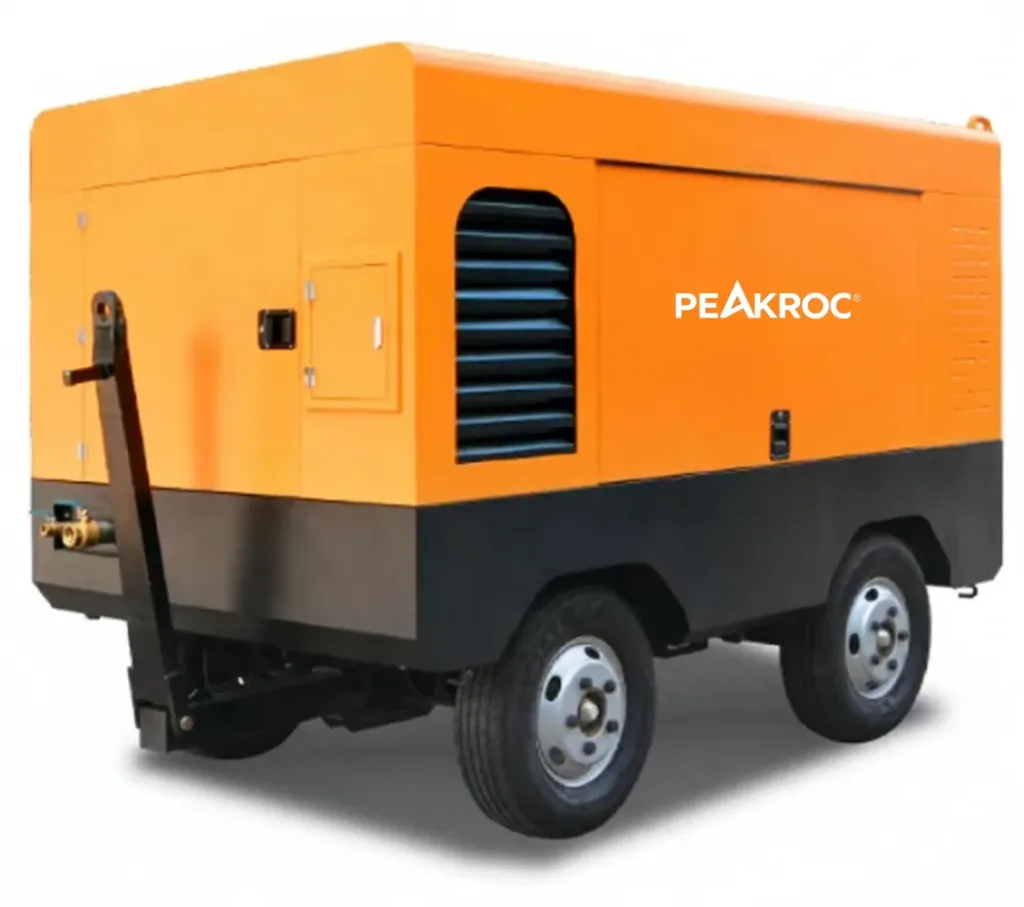
Two hammers with the same nominal diameter can have different internal designs and different compressed-air requirements.
For example, two nominal 4-inch DTH hammers may require different FAD values at the same working pressure.
The correct reference is the manufacturer’s performance chart for the specific hammer model.
A preliminary compressor sizing relationship is:
Required Compressor FAD ≥ Hammer Air Consumption + Simultaneous Auxiliary Air Demand + Justified Operating Margin
All flow values in this comparison must use compatible reference conditions, and the compressor must deliver the required FAD at the relevant working pressure.
The margin should reflect actual operating uncertainty and expected losses, not an arbitrary percentage applied to every project.
Importantly, distribution leakage and pressure drop affect the system differently. Pressure loss should be calculated in the pressure requirement rather than treated as though it can always be corrected by adding a fixed percentage to FAD.
Understand CFM, FAD and m³/min
CFM means cubic feet per minute, while m³/min means cubic meters per minute.
These are volumetric airflow units.
FAD, or Free Air Delivery, represents actual delivered compressor capacity expressed relative to defined free-air conditions.
The conversion is:
1 m³/min ≈ 35.31 CFM
For example, 22 m³/min corresponds to approximately 777 CFM, while 34 m³/min corresponds to approximately 1,201 CFM.
However, those conversions do not establish whether the compressor can operate a particular DTH hammer.
The quotation must specify the airflow available at the required operating pressure.
A compressor delivering 1,200 CFM at 10 bar cannot automatically be treated as equivalent to one delivering 1,200 CFM at 25 bar.
The airflow figure must also be identified as actual FAD rather than theoretical compressor displacement.
Hole Diameter and Drill-Pipe Size Affect Flushing
Compressed air must do more than operate the hammer.
It must also remove cuttings from the bottom of the borehole.
Air returns toward the surface through the annular space between the drill pipe and the borehole wall.
The available annular area depends on the borehole diameter and drill-pipe outside diameter.
For a simplified circular annulus:
Annular Area = π × (Hole Diameter² − Drill-Pipe Outside Diameter²) / 4
A larger annular area requires more actual volumetric flow to maintain the same average upward velocity.
Consequently, increasing bit diameter without reconsidering airflow can reduce cuttings-transport effectiveness.
However, actual downhole airflow differs from compressor FAD because air expands and changes density as pressure and temperature vary.
A proper flushing assessment must use local downhole conditions rather than directly substituting free-air volume into an annular-velocity calculation.
How Does Groundwater Affect Geothermal DTH Drilling?
Groundwater is one of the most important differences between a straightforward dry hard-rock borehole and a demanding geothermal drilling project.
Water can enter through permeable formations, fractures or other water-bearing zones.
This changes the pressure environment and the behavior of cuttings returning through the borehole.
Understanding Hydrostatic Backpressure
A water column creates hydrostatic pressure.
For a static column of fresh water, pressure can be approximated using:
P = ρgh
Where ρ is water density, g is gravitational acceleration and h is the vertical water-column height.
Under ordinary conditions, a 10-meter fresh-water column creates approximately 0.98 bar of hydrostatic pressure.
A 30-meter column creates approximately 2.94 bar.
These values describe static water pressure, not the total pressure that must be added directly to a compressor rating.
The actual drilling requirement depends on where water is present, the fluid mixture, borehole geometry, return-flow behavior and hammer operating conditions.
For example, a 100-meter-deep borehole does not automatically contain a 100-meter water column acting against the hammer.
The water level could be substantially below the surface, and the pressure environment can change while air is circulating.
Therefore, compressor pressure cannot be selected from borehole depth alone.
Groundwater Changes Cuttings Removal
In a dry borehole, air may transport rock cuttings through the annulus with comparatively simple flow behavior.
When groundwater enters, the returning flow may contain air, water and rock particles.
This multiphase mixture behaves differently from dry air carrying cuttings.
Wet cuttings may accumulate, and the hammer may experience increased backpressure.
If the compressed-air system cannot maintain effective circulation, drilling productivity may decline.
Increasing compressor pressure may help in some compatible high-pressure DTH applications, but a different flushing method, casing arrangement or drilling technique may be more appropriate in others.
Five Warning Signs That Water Conditions Are Changing
- Unexpected reduction in penetration rate: The hammer may be experiencing altered backpressure, poor flushing or other changes in drilling conditions.
- Increasing water discharge at the surface: The borehole may have intersected a more productive water-bearing zone.
- Wet cuttings accumulating in the hole: The current air circulation may no longer transport the mixture effectively.
- Unstable compressor loading or pressure behavior: Changing air demand, losses or downhole conditions may be affecting the system.
- Repeated hole-cleaning problems: Additional investigation may be required before continuing with the same drilling method.
None of these symptoms proves that the compressor is undersized.
A reliable assessment should distinguish groundwater effects from hammer wear, drill-bit condition, inappropriate feed force and other equipment problems.
Does Geothermal Drilling Require 20, 25 or 35 Bar?
Portable high-pressure compressors are used in demanding DTH drilling, including some geothermal applications.
However, pressure classes should not be assigned solely according to whether the project is shallow, medium-depth or deep.
The compressor must operate within the hammer manufacturer’s approved conditions while overcoming relevant air-distribution losses and downhole resistance.
When 20 Bar May Be Appropriate
A 20-bar compressor may be considered when the selected DTH hammer operates within a compatible pressure range and the required FAD can be maintained.
For some hard-rock geothermal boreholes, this class may provide a practical balance between pressure, airflow and equipment size.
However, a 20-bar rating does not guarantee suitability for a particular depth or formation.
The hammer specification and drilling-system losses still determine the operating requirement.
When 25 Bar May Be Appropriate
A 25-bar compressor provides approximately 363 PSI of rated working pressure.
It may be considered when the hammer requires a higher operating pressure or when downhole conditions create additional resistance that must be accommodated.
For contractors operating across changing geological conditions, a correctly designed adjustable-pressure system may improve flexibility.
However, if the hammer is designed to operate at substantially lower pressure, supplying 25 bar directly to it may be unsuitable or damaging.
Pressure regulation must maintain the hammer’s approved operating range.
When 35 Bar May Be Justified
A 35-bar compressor provides approximately 508 PSI.
This class is relevant to certain high-pressure DTH systems and specialized drilling requirements.
Potential reasons to consider greater pressure capability include a compatible high-pressure hammer, significant downhole backpressure and difficult circulation conditions.
But a higher-pressure machine does not automatically deliver greater FAD.
For example, a compressor rated at 33 m³/min and 35 bar has a different performance profile from one rated at 34 m³/min and 25 bar.
The latter may offer slightly more nominal airflow but less working-pressure capability.
Selection must be based on the operating point, not whichever number appears larger.
The correct compressor is the one that delivers the required FAD at an allowable hammer pressure after system losses—not necessarily the unit with the highest maximum bar rating.
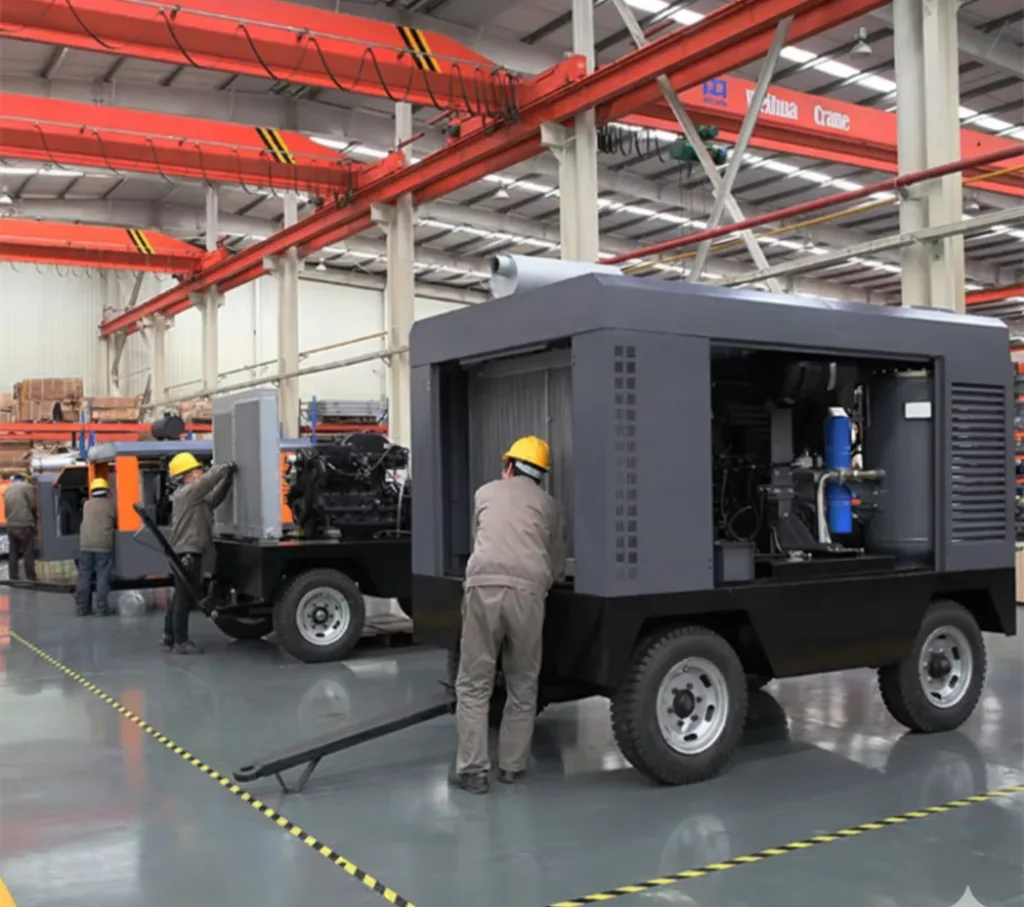
Five-Step Geothermal DTH Compressor Sizing Procedure
A practical selection process should proceed in the following order.
- Step 1 — Define the drilling method and tool. Confirm whether compressed air will power a DTH hammer, support air rotary drilling or serve another defined function. Obtain the exact hammer or air-tool model.
- Step 2 — Establish the required operating pressure. Use the hammer manufacturer’s operating range, then assess drill-string restrictions, hose losses and expected downhole backpressure.
- Step 3 — Determine required FAD. Obtain the hammer’s air-consumption data at the intended working pressure, then account for auxiliary demand and a justified margin.
- Step 4 — Correct for jobsite conditions. Evaluate elevation, ambient temperature, hose configuration, continuous-duty requirements and expected changes in geology or groundwater.
- Step 5 — Compare complete compressor packages. Verify guaranteed FAD at pressure, adjustment range, engine capability, fuel consumption, mobility, maintenance support and total project cost.
Why Altitude and Temperature Matter
Portable diesel compressors may operate on remote or elevated geothermal drilling sites.
At higher elevations, lower atmospheric pressure reduces the density of incoming air.
High ambient temperature can also affect compressor and engine performance.
The effect varies according to engine configuration, compressor design and control system.
Therefore, buyers should request manufacturer-specific performance or derating information for the project conditions.
Do not assume that a compressor will deliver its catalogue FAD under every combination of altitude and temperature.
Why Hose and Drill-String Losses Matter
The compressor outlet is not the final point where compressed air performs useful work.
Air may travel through hoses, fittings, valves, drill pipes and other equipment before reaching the hammer.
These components create flow resistance.
A long hose with an unsuitable internal diameter can cause significant pressure loss.
Likewise, drill-string restrictions can affect the pressure available at the hammer.
This means a compressor with an apparently sufficient pressure rating may perform poorly if the air distribution system is incorrectly designed.
Pressure-loss calculations should use the actual flow, operating pressure, pipe dimensions and relevant equipment characteristics.
Geothermal Drilling Cost: Why Fuel Consumption per Meter Is More Useful
Purchase price is only one part of the compressor selection decision.
Geothermal drilling contractors should evaluate operating cost over the full drilling cycle.
A compressor may consume relatively little diesel per hour but take longer to complete the work because its air delivery is insufficient.
Conversely, a much larger compressor may provide more capacity than the hammer and drilling conditions can use economically.
A useful operating measure is:
Compressor Fuel Cost per Meter = Total Compressor Fuel Cost / Meters Successfully Drilled
This can be expanded to include servicing, downtime, labor and other project costs.
However, geothermal borehole construction has an additional consideration.
The project is not complete merely because the drill bit reaches the target depth.
The borehole must be suitable for the intended heat exchanger, completion and sealing procedure.
For that reason, cost per successfully completed geothermal borehole can be more informative than penetration rate alone.
A drilling setup that works quickly in competent rock but frequently encounters hole-cleaning or stability problems may not provide the lowest total installation cost.
Technical Field References
Published field projects and technical research provide useful evidence of how compressor selection and groundwater conditions affect geothermal work.
The following references illustrate real operating conditions. They are external industry examples, not Peakroc® customer projects.
Field Reference 1: Near-Surface Geothermal Compressor Evaluation in Germany
In autumn 2023, German geothermal contractor Baugrund Süd Gesellschaft für Geothermie mbH evaluated a prototype portable compressor during approximately one month of site operation.
The published account identifies near-surface geothermal applications and geothermal probe construction among the activities.
The evaluated compressor provided adjustable pressure within approximately the 16–25 bar range and a specified airflow range of about 19.2–21 m³/min, depending on operating conditions.
The contractor highlighted fuel efficiency, transportability and ease of operation as important advantages.
Engineering lesson: For repetitive geothermal borehole installations, compressor efficiency, equipment mobility and the ability to match operating conditions may matter as much as maximum pressure.
This example demonstrates real geothermal drilling use of a portable high-pressure compressor.
However, the published customer account does not provide a complete independent dataset for fuel consumption per meter, drilling depth or head-to-head compressor performance.
Those results should not be inferred.
Field Reference 2: High-Pressure Compressed Air in a Deep Geothermal Project in France
A publicly documented project involving Fonroche Géothermie in the Strasbourg region required specialized compressed-air equipment for deep geothermal wells.
The project involved two boreholes extending more than 5,000 meters underground.
The reported temporary equipment package included two compressors capable of up to 35 bar, together with a high-pressure booster operating at approximately 90 bar.
The equipment supported well testing and preparation for production.
Engineering lesson: Deep geothermal projects can require a coordinated high-pressure air system rather than a single conventional portable compressor.
This distinction is particularly important when comparing deep geothermal energy projects with ordinary ground-source heat pump boreholes.
The published project does not establish that the entire 5,000-meter borehole was drilled using a 35-bar DTH hammer. The high-pressure system’s documented role included testing and production-related operations.
Therefore, it should not be used to claim that 35 bar alone is sufficient for drilling geothermal wells to that depth.
Field Reference 3: Groundwater Variation in French Geothermal Research Boreholes
Researchers studying a shallow geothermal research facility in Orléans, France, investigated four borehole heat exchangers.
The boreholes were approximately 60 meters deep and spaced about eight meters apart.
Thermal measurements revealed that groundwater flow affected the thermal response of some boreholes differently from neighboring installations.
In two boreholes, enhanced heat transfer associated with groundwater movement was observed over a zone approximately 25–40 meters below the surface.
Engineering lesson: Groundwater behavior can vary significantly over short distances within the same geothermal installation.
For drilling contractors, this reinforces the need to consider local hydrogeology instead of assuming identical underground conditions throughout an entire borefield.
This was a thermal-response investigation rather than a compressor comparison or DTH drilling performance test.
It provides evidence of groundwater variability, not a measured requirement for a particular compressor pressure or airflow.
Common Mistakes When Selecting a Geothermal Drilling Compressor
One common mistake is selecting a compressor before confirming the drilling method.
A contractor may focus on purchasing a 25-bar compressor because the project is described as geothermal drilling, even though the expected formation requires primarily mud rotary drilling.
Another mistake is selecting pressure directly from the planned borehole depth.
The actual pressure requirement depends on the hammer, drilling-system losses and relevant downhole resistance.
A third mistake is assuming that the largest CFM rating is automatically best.
A large airflow rating at low pressure cannot replace the operating pressure required by a compatible high-pressure DTH hammer.
Conversely, greater pressure without adequate FAD may fail to provide sufficient hammer operation or cuttings transport.
Groundwater is also frequently oversimplified.
Water inflow may require changes in circulation strategy, borehole support or drilling technique, rather than merely installing a higher-pressure compressor.
Finally, equipment buyers should avoid comparing machines using only ideal catalogue conditions.
Real geothermal sites may involve long operating shifts, elevated temperatures, remote locations and changing drilling requirements.
These factors must be considered before finalizing the compressor selection.
What Information Should Contractors Provide When Requesting a Quotation?
A useful geothermal drilling compressor inquiry should provide enough detail to evaluate the actual drilling system.
Five-Part Geothermal Compressor RFQ Checklist
- Project type: Ground-source heat pump boreholes, direct-use geothermal drilling or another specific geothermal application; include project country and operating location.
- Borehole requirements: Target depth, hole diameter, estimated number of boreholes, formation sequence and expected groundwater conditions.
- Drilling equipment: Rig manufacturer and model, drilling method, exact DTH hammer model, bit diameter and drill-pipe dimensions.
- Compressed-air requirements: Manufacturer-rated hammer pressure and FAD, expected hose length, auxiliary air consumers and any pressure adjustment requirements.
- Jobsite and procurement conditions: Site elevation, maximum ambient temperature, working hours, fuel availability, required mobility, maintenance support and delivery requirements.
A practical preliminary inquiry could read:
We are installing vertical geothermal boreholes in a formation containing weathered overburden and competent basalt. The target depth is approximately 150 meters per borehole, with a planned hole diameter of 140 mm. We expect groundwater in fractured zones and intend to use a DTH hammer after casing the unstable upper section. Please recommend a portable diesel compressor based on our hammer’s operating-pressure and air-consumption specifications, taking into account groundwater, hose losses and site conditions.
The hammer manufacturer and exact model would still be required before confirming the compressor’s pressure and FAD.
This information is far more useful than a request stating only that a 25-bar geothermal compressor is needed.
Final Recommendation
Geothermal borehole drilling does not have one universal compressor requirement.
The correct choice begins with geology and drilling method.
DTH air drilling can be effective in competent hard rock, while mud rotary or another supported drilling technique may be preferable in unstable ground.
When a DTH hammer is selected, its actual air-consumption curve becomes the starting point for compressor sizing.
Borehole depth, groundwater, drill-pipe dimensions, hose losses, altitude and operating temperature must then be considered.
The 20–35 bar range provides several possible high-pressure compressor classes, but higher pressure is justified only when the selected tool and drilling conditions require it.
For geothermal contractors, the best equipment decision should also account for fuel consumption, reliability, serviceability and the number of successfully completed boreholes.
The most suitable geothermal drilling compressor is not the largest machine available. It is the one that delivers the required FAD at the correct operating pressure, supports effective hole cleaning and remains productive under the actual geological conditions.
FAQ
What type of air compressor is used for geothermal borehole drilling?
Portable diesel rotary screw compressors are commonly used when geothermal borehole drilling relies on air-powered DTH hammers or air circulation. The required compressor depends on hammer pressure, air consumption, borehole conditions and drilling method. Mud rotary drilling may instead use a fluid circulation pump as its primary support equipment.
Is DTH drilling better than mud rotary for geothermal boreholes?
DTH drilling is often effective in competent hard rock, while mud rotary drilling may be more suitable in loose or unstable formations. Neither method is universally better. The choice depends on geology, groundwater, borehole stability and the required completion method.
How much CFM does a geothermal DTH drilling compressor need?
There is no universal CFM requirement. The compressor must deliver the specific DTH hammer’s rated air consumption at the required working pressure, together with any auxiliary demand and an appropriate operating margin. Hole diameter, drill-pipe dimensions and cuttings-removal conditions must also be assessed.
Is a 25-bar compressor enough for geothermal drilling?
A 25-bar compressor may be suitable when the selected DTH hammer operates within a compatible pressure range and the available FAD meets the drilling requirement. Some applications require less pressure, while others may justify greater pressure. Depth alone does not determine the correct rating.
When would a geothermal drilling project require a 35-bar compressor?
A 35-bar compressor may be considered for compatible high-pressure DTH systems facing demanding downhole backpressure or other operating conditions. The hammer’s approved pressure, required FAD and actual circulation requirements must be verified before selection.
How does groundwater affect DTH compressor sizing?
Groundwater can introduce hydrostatic backpressure and create a mixture of air, water and cuttings in the borehole. This can change hammer performance and hole-cleaning requirements. The correct response may involve additional air capacity, different circulation methods or changes in drilling technique.
Does a deeper geothermal borehole always require higher air pressure?
No. Greater depth can increase drill-string losses and complicate circulation, but pressure requirements depend on hammer design, groundwater level, fluid conditions and system geometry. There is no universal pressure increase per meter of borehole depth.
What information is needed to choose a geothermal drilling compressor?
The main information includes drilling method, DTH hammer model, required pressure and FAD, hole diameter, drill-pipe dimensions, target depth, formation, groundwater conditions, site altitude, ambient temperature and expected duty cycle. These details allow meaningful compressor sizing and quotation comparison.
Author

Mark Chen – Senior Mechanical Engineer, Peakroc®
Mark Chen is a senior mechanical engineer at Peakroc®, specializing in compressed air systems and drilling equipment for mining and construction applications. With over 15 years of field experience, he has led multiple projects on optimizing air delivery efficiency, equipment durability, and energy consumption.