
Key Takeaways
- There is no single “slope stabilization compressor size.” Compressor selection should start with the drilling method, hammer or tool, hole diameter, depth and geology, then move to required FAD and working pressure.
- For medium-pressure ground-engineering work, Peakroc’s PRMD-2013 provides 20 m³/min at 13 bar and is currently listed for micropile installation, soil nailing and rock anchoring. Peakroc PRMD-2013 20 m³/min 13 bar compressor
- When harder rock or the DTH hammer requires more pressure, Peakroc’s next class includes 22 m³/min at 20 bar, while the 25-bar range provides approximately 24, 34 and 39 m³/min depending on the required airflow.
- Higher pressure is not automatically better. Pressure drives the hammer; airflow supports hammer cycling and removes cuttings. A compressor needs enough of both at the actual drilling tool.
- Long hoses, small internal diameters and restrictive fittings reduce pressure before the air reaches the rig. Peakroc’s construction/mining system-design guidance recommends treating the compressor and air-delivery system as one system rather than relying only on nameplate pressure. Compressed Air System Design Guide
Slope stabilization covers several very different types of work. A contractor may be installing relatively shallow soil nails in weathered ground, drilling rock bolts into a highway cut, installing long anchors through fractured rock, or drilling micropiles into granite for a retaining structure. All of these may be described as “slope stabilization,” but their compressed-air requirements can be very different.
For compressor selection, the application name is therefore only the starting point. The more useful sequence is:
Drilling Method → Hole Diameter → Hammer/Tool → Depth → Geology → FAD/CFM → Pressure → Air Delivery System
Once these variables are known, choosing between a 13-bar, 20-bar or 25-bar compressor becomes much easier.
Compressed Air Requirements for Slope Stabilization Drilling
Rock slopes are commonly strengthened by inserting reinforcing elements into drilled holes and bonding them into the surrounding ground. FHWA describes rock anchors as threaded steel bars or cables installed through drilled holes and bonded with cement grout or resin; rock bolts and dowels can reinforce individual blocks or stabilize larger areas of fractured rock. Anchor lengths vary considerably with slope geometry, rock structure and engineering design.
Soil nailing follows the same general reinforcement principle but is commonly used to strengthen soil cuts and excavations, while micropiles may provide deeper structural support or load transfer. The drilling method can be rotary, self-drilling, top hammer or DTH depending on the ground and project design. Compressed air may be used only for flushing in one project, while in another it must both power a DTH hammer and continuously lift rock cuttings out of the borehole.
This distinction is the foundation of compressor sizing. In DTH drilling, pressure and airflow perform different but equally important jobs. Pressure helps drive the hammer piston and maintain impact energy, while airflow keeps the hammer cycling and carries broken rock to the surface. If pressure is too low, penetration suffers; if airflow is too low, cuttings accumulate and the hole may not clean efficiently even though the pressure gauge looks satisfactory.
Start With the Hammer, Hole Diameter and Geology
A common mistake is to ask for a “rock anchoring compressor” without specifying the drilling tool. The same slope may contain weathered soil near the surface and competent granite deeper inside, and a contractor may change from rotary drilling to DTH once harder material is reached. Compressor demand changes with that decision.
Hole diameter is especially important because larger DTH hammers generally consume more air, and larger boreholes require more airflow to lift cuttings. Depth adds another variable: the farther the air travels through the drilling system and borehole, the harder it becomes to maintain effective flushing. Groundwater can also create backpressure, while fractured or highly permeable rock may change how the compressed air behaves in the hole.
For that reason, the most useful specification when requesting a compressor is not simply:
“We are drilling anchors.”
It is something closer to:
DTH hammer model + bit diameter + target depth + geology
The hammer manufacturer’s operating-air data should then provide the basis for the required compressor FAD and pressure.
How Much Pressure Is Needed?
There is no universal pressure for soil nailing, micropiling or rock anchoring. Some rotary and shallow drilling jobs can operate at relatively moderate pressure, while hard-rock DTH drilling may require substantially more. A useful way to think about pressure classes is shown below.
| General Drilling Condition | Practical Compressor Direction |
|---|---|
| Light flushing / softer formations | Lower-pressure construction class may be sufficient |
| Medium-depth anchoring and ground engineering | Around 10–13 bar can be a useful starting class |
| Harder rock / higher-pressure DTH | Around 18–20 bar may be required |
| Difficult hard rock, larger hammer or demanding backpressure | 20–25+ bar may be justified |
These are selection directions rather than fixed design limits. Final pressure must follow the drilling tool and actual formation.
Peakroc’s current range illustrates this progression well. The PRMD-2013 provides 20 m³/min at 13 bar, while the PRMD-2220 steps up to 22 m³/min at 20 bar for harder or deeper drilling. Peakroc’s 25-bar line then includes approximately 24, 34 and 39 m³/min configurations when both sustained pressure and greater flushing airflow are needed.
The important point is not to move automatically to 25 bar “for safety.” Higher-pressure equipment usually costs more to purchase and operate, and a large compressor may also be heavier and less convenient on constrained slope sites. The better approach is to use the lowest pressure class that comfortably satisfies the hammer, flushing requirement and expected site losses.
CFM/FAD Is Just as Important as Bar
Pressure often gets more attention because it is easy to compare numbers such as 13, 20 and 25 bar. But airflow is equally important. A compressor must supply enough Free Air Delivery (FAD) to keep the hammer operating correctly and maintain sufficient upward air velocity to remove cuttings from the borehole.
This becomes especially important as hole diameter increases. A higher-pressure compressor with insufficient airflow may maintain hammer impact but still leave cuttings accumulating around the bit. That can reduce penetration, increase re-drilling and make the drilling system appear underpowered even though the pressure itself is adequate.
Peakroc’s current 25-bar range demonstrates why several airflow classes exist at the same pressure. Approximately 24 m³/min at 25 bar serves a different hammer and hole-cleaning requirement from 39 m³/min at 25 bar. Both machines have the same nominal pressure, but they are not interchangeable from an airflow perspective.
A useful rule is:
Pressure should match the hammer requirement; FAD should match hammer consumption plus reliable hole cleaning.
Depth, Groundwater and Hose Loss Change What Reaches the Drill
Compressor ratings are normally measured at the compressor discharge. The drilling tool is often tens of meters away. Between those two points are hoses, couplings, manifolds, lubricators and rig plumbing, all of which create some pressure loss.
Peakroc’s existing compressed-air system design guide emphasizes this point: undersized hoses, excessive hose length and restrictive fittings can prevent a correctly sized compressor from delivering its rated performance at the tool. For typical construction and mining air systems, the objective should be to keep the delivery path as unrestricted as practical rather than compensating for poor air distribution by simply increasing compressor pressure.
For slope work, this matters because the compressor may be parked at road level while the drill rig is positioned higher on a slope. A long hose may need to run around barriers or up temporary access routes, adding both distance and fittings. The useful design question is therefore not:
“Does the compressor produce 13 bar?”
but:
“How much pressure and airflow are available at the drill while the hammer is working?”
The usual improvements are straightforward: use the largest practical hose ID, keep the run reasonably short, avoid undersized couplings and minimize unnecessary fittings. Peakroc’s own construction/mining guide shows how dramatically pressure loss rises when high airflow is forced through a small hose.
Industry Case: Granite Slope Reinforcement in South Korea
A 2025 residential development project in Gyeonggi Province, South Korea provides a useful example of why compressor selection must follow geology rather than the application name alone. The project involved retaining-wall construction, micropiling and slope reinforcement in granite-rich terrain.
The contractor had previously been working with a compressor in the 17–21 bar range delivering approximately 25.5 m³/min / 900 CFM, but reported difficulty achieving the drilling speed and depth required in the granite. The project subsequently moved to a system with a wider 16–30 bar operating range, suitable for work including earth anchors, soil nailing, rock bolts and micropiling.
The point of this case is not that slope stabilization always needs 30 bar. In softer ground or shallower holes, that would be unnecessary. The practical lesson is that the same category of construction work can move into a much higher pressure class when harder formations, greater depth or more demanding drilling tools are introduced.
It also demonstrates why geology should be included in every compressor RFQ. Simply telling a supplier that the project involves “micropiles” or “soil nailing” leaves out one of the variables most likely to change the required compressor class.
Matching Peakroc Compressor Classes to the Work
For medium-pressure ground engineering, the PRMD-2013 at 20 m³/min and 13 bar is a logical reference point. Peakroc currently lists foundation and anchoring work—including micropiles, soil nailing and rock anchoring—among its applications.
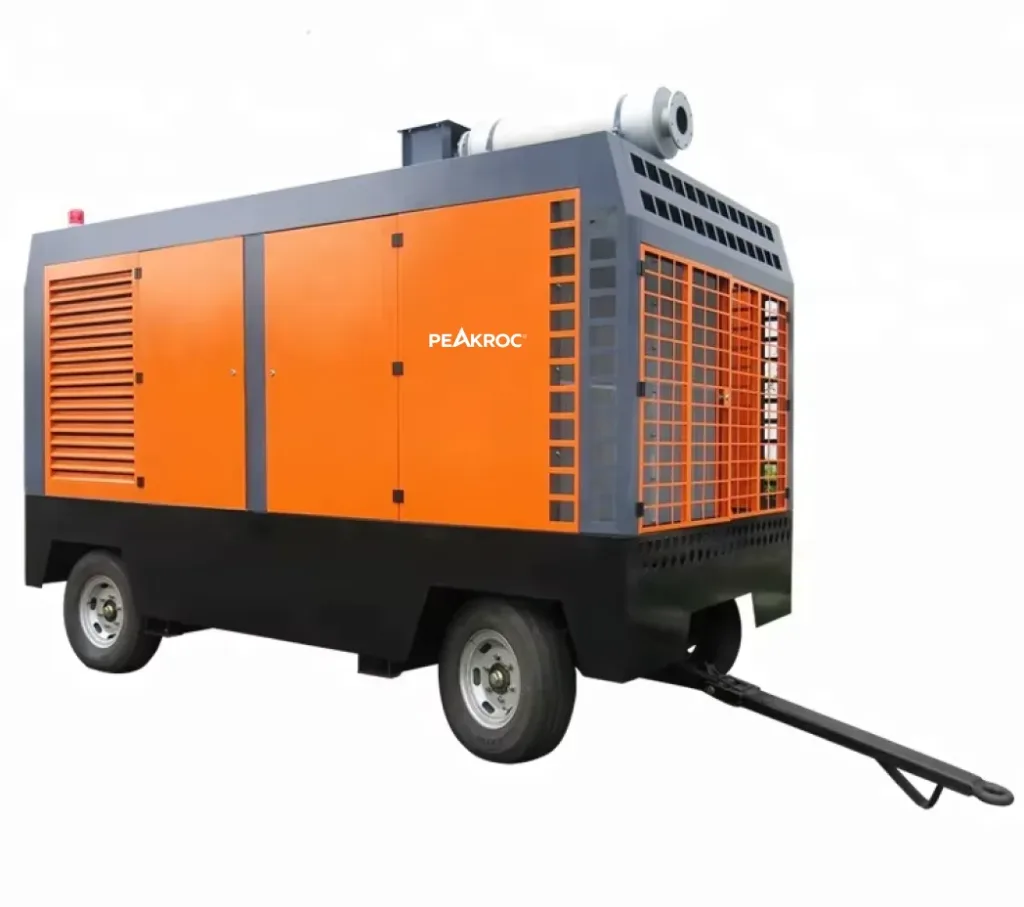
When the hammer or geology requires more pressure but a similar airflow class remains appropriate, the PRMD-2220 at 22 m³/min and 20 bar provides the next step. For projects genuinely requiring high-pressure DTH performance, the 25-bar range begins around 24 m³/min and extends to 34 and 39 m³/min for larger air demand and more difficult hole cleaning.
That does not mean the largest model is automatically preferable. A useful selection pattern is:
| Project Condition | Peakroc Capacity Direction |
|---|---|
| Medium-pressure soil nailing / anchoring | 20 m³/min @ 13 bar class |
| Harder rock / higher-pressure DTH requirement | 22 m³/min @ 20 bar class |
| Demanding DTH / larger airflow requirement | 24–39 m³/min @ 25 bar class |
The final selection should still come from the drilling tool. If the hammer manufacturer calls for 18 bar and 20 m³/min, buying a 25-bar machine does not automatically improve the project. Conversely, if the hammer requires 22–25 bar in difficult granite, a 13-bar machine cannot compensate with extra airflow alone.
Soil Nailing, Rock Anchors and Micropiles Are Not the Same Air Demand
Soil nailing often involves relatively closely spaced holes installed progressively as excavation proceeds. Depending on the soil and weathered rock, rotary or self-drilling methods may be practical, meaning compressed air demand can be moderate compared with hard-rock DTH drilling.
Rock anchors and rock bolts are more strongly influenced by the condition of the rock mass. FHWA notes that anchors may stabilize individual loosened blocks or entire fractured slopes and can vary significantly in length. Where hard rock requires pneumatic percussion, DTH drilling can push compressor pressure and airflow upward.
Micropiles can introduce another level of demand because hole size, depth and difficult ground may all increase. The South Korean case demonstrates this clearly: the work was still “slope reinforcement,” but granite-rich geology and micropiling requirements made the compressor specification substantially more demanding.
So the safest way to size the system is not to assign one compressor to each application name. Instead, use the application to understand the project, then size from the actual drilling tool, hole and geology.
What Information Should You Send for a Quote?
A useful slope-stabilization compressor RFQ does not need to be complicated. The following information is normally enough to begin a serious selection:
| Information | Example |
|---|---|
| Application | Rock anchoring / soil nailing / micropile |
| Drilling method | DTH / rotary / self-drilling |
| Hammer model | 4″, 5″, 6″ or exact model |
| Hole diameter | 115 mm / 150 mm / 200 mm |
| Target depth | 15 m / 30 m / 50 m |
| Geology | Soil / weathered rock / limestone / granite / basalt |
| Airflow requirement | m³/min or CFM, if known |
| Pressure requirement | bar or PSI, if known |
| Hose length | Compressor to drill |
| Altitude | Project elevation |
| Ambient temperature | Expected maximum |
| Number of rigs | One or multiple |
If airflow and pressure are unknown, the most valuable information is usually:
Hammer model + bit diameter + target depth + geology
From there, the hammer’s air-consumption data can be matched to the compressor.
Final Recommendation
A portable compressor for slope stabilization should not be selected from pressure alone, and it should not be selected simply because another project also involved anchors or micropiles. The same application can require very different compressed-air systems depending on geology, tool size and drilling method.
A practical selection sequence is:
Drilling Method → Hammer → Hole Diameter → Depth → Geology → CFM/FAD → Pressure → Hose Loss → Compressor
For many medium-pressure anchoring and ground-engineering projects, the 20 m³/min / 13 bar class is a useful starting point. Harder rock or a more demanding DTH hammer may move the project toward 20 bar, while truly high-pressure drilling may justify 25 bar.
The best compressor is therefore not the machine with the highest pressure number. It is:
the compressor that delivers the airflow and pressure required by the drilling tool while maintaining reliable hole cleaning under the actual ground and site conditions.
FAQ
What size air compressor is needed for slope stabilization?
There is no universal size. Start with the drilling method, hammer, hole diameter, depth and geology. Medium-pressure work may fit a 13-bar class, while hard-rock DTH anchoring may require 20–25 bar.
Is 13 bar enough for rock anchoring?
It can be suitable for many medium-pressure anchoring and foundation applications. Peakroc currently lists the 20 m³/min, 13 bar PRMD-2013 for micropiles, soil nailing and rock anchoring.
When should I move from 13 bar to 20 bar?
A higher pressure class becomes relevant when the DTH hammer requires it, the formation becomes harder, the hole becomes more demanding or pressure loss/backpressure prevents adequate hammer performance.
When is a 25 bar compressor needed?
A 25-bar compressor is mainly justified when the hammer and drilling conditions genuinely require high pressure, such as harder rock, larger DTH systems or demanding hole-cleaning conditions. Peakroc’s 25-bar range includes several airflow classes because pressure alone does not define the application.
Does hole diameter affect compressor airflow?
Yes. Larger holes normally use larger tools and require more flushing air to remove cuttings. Always check the hammer manufacturer’s air-consumption data for the intended bit size and operating pressure.
Does hose length affect DTH drilling?
Yes. Hose friction and restrictive fittings reduce pressure between the compressor and drill. Large airflow through an undersized hose can create substantial pressure loss.
Is DTH drilling always necessary for soil nailing?
No. Soil nailing may use rotary, self-drilling or other methods depending on ground conditions. DTH becomes more relevant when hard rock or difficult formations require pneumatic percussion.
Author

Mark Chen – Senior Mechanical Engineer, Peakroc®
Mark Chen is a senior mechanical engineer at Peakroc®, specializing in compressed air systems and drilling equipment for mining and construction applications. With over 15 years of field experience, he has led multiple projects on optimizing air delivery efficiency, equipment durability, and energy consumption.