
Key Takeaways
- Size a demolition compressor from the rated air consumption of the pneumatic breakers that can operate simultaneously, not simply from the number of tools connected to the manifold.
- Most conventional paving breakers work around 6–7 bar / approximately 90 PSI, while actual air consumption varies significantly with breaker size and design. Published specifications show roughly 49–78 CFM across several common breaker sizes.
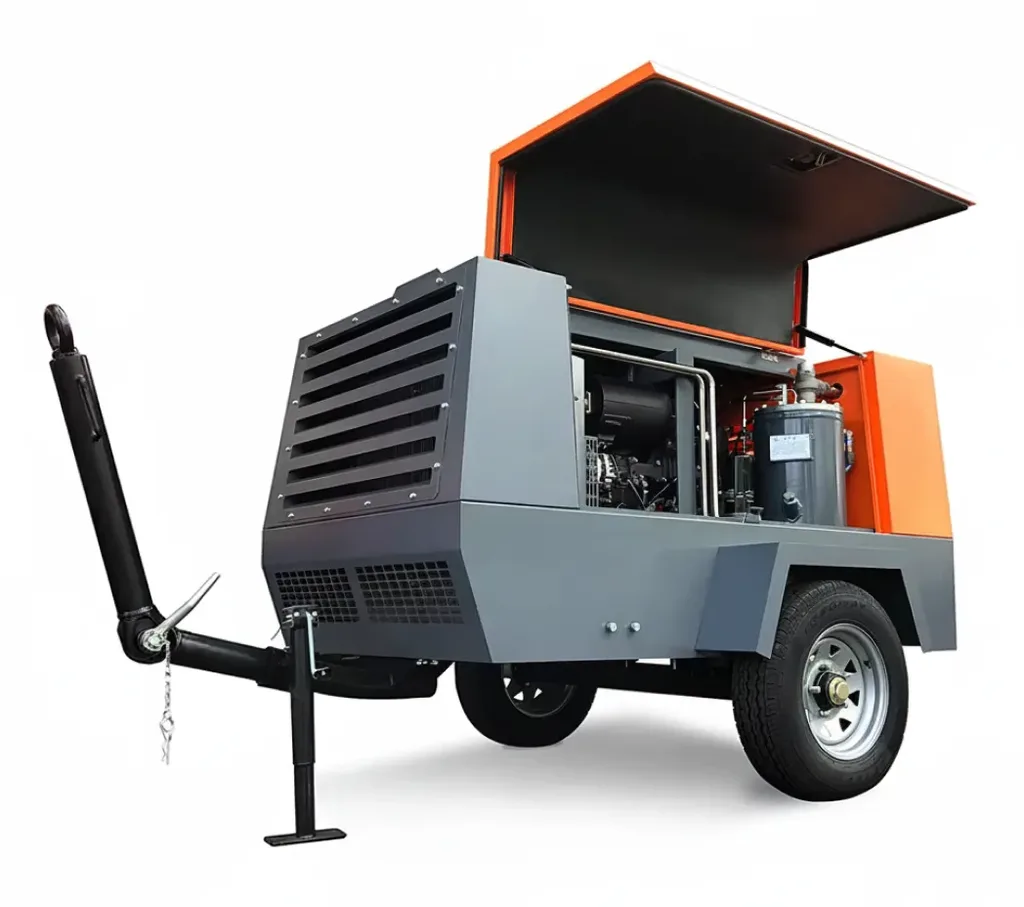
- For one heavy breaker or a small demolition crew, the Peakroc® 5 m³/min, 7 bar portable diesel compressor provides approximately 185 CFM and is designed for pneumatic breakers, chipping hammers and concrete surface-removal work.
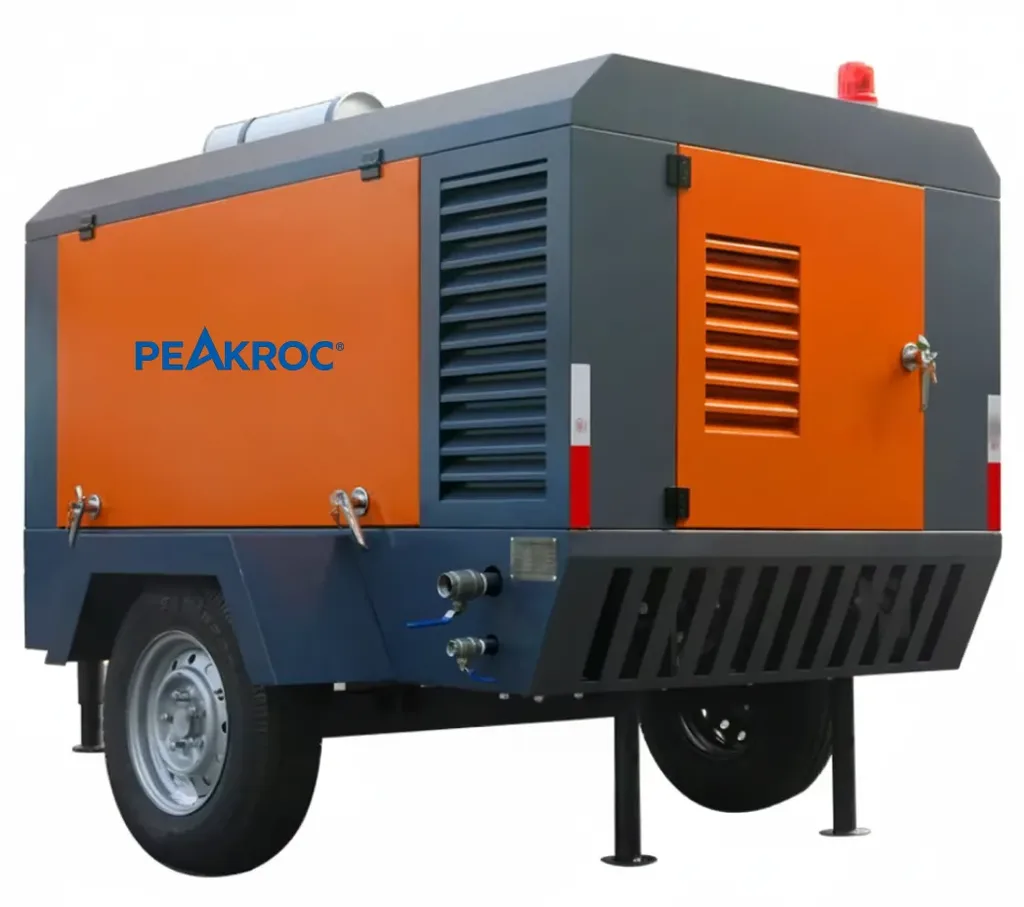
- For crews running several tools simultaneously, the Peakroc® 10 m³/min, 8 bar PRMD-1008 provides 375 CFM and is designed for 2–4 construction tools, including concrete and asphalt breakers.
- A compressor gauge showing 7 or 8 bar does not prove the breaker is receiving that pressure. Hose diameter, hose length, couplings, leakage and filters all reduce pressure between the compressor and the tool.
- Avoid buying a high-pressure drilling compressor simply because it is larger. Concrete breakers generally need moderate pressure and sufficient continuous airflow, so excess pressure can increase fuel consumption without improving demolition productivity.
Concrete demolition looks like a pressure-intensive application.
In reality, it is usually an airflow-intensive application at moderate pressure.
A pneumatic breaker may only need around 6–7 bar to operate correctly, but it needs that pressure while consuming substantial airflow continuously.
This distinction explains one of the most common problems on demolition sites:
The compressor pressure gauge looks normal, but the breaker still feels weak.
The cause is often not insufficient compressor pressure.
It is insufficient CFM at the tool.
The useful sizing sequence is therefore:
Breaker Air Consumption → Simultaneous Tools → Required FAD → Working Pressure → Hose Loss → Site Conditions → Compressor Size
Start With the Breaker, Not the Compressor
The first question should not be:
“Do we need a 185 CFM or 375 CFM compressor?”
Start with the pneumatic tools.
Record the manufacturer’s rated:
- air consumption;
- working pressure;
- hose requirement;
- number of operators.
Paving breakers vary substantially.
Published specifications for pneumatic demolition tools show examples ranging from approximately:
49 CFM for a lighter breaker
to:
64–78 CFM for larger paving breakers
at around 6 bar operating pressure. Other heavy-duty models can approach or exceed 90 CFM.
That means two breakers that look similar on a jobsite may place significantly different demands on the compressor.
The basic calculation is:
Required Tool Airflow = Sum of Rated CFM for All Simultaneously Operating Tools
Suppose a crew uses:
2 breakers × 80 CFM each
plus:
1 tamper × 35 CFM
If all three can operate at the same time:
160 + 35 = 195 CFM
A 185 CFM compressor is already below the theoretical simultaneous demand before hose loss, altitude, filter loading or leakage are considered.
That is why compressor selection should be based on peak simultaneous demand, not average air consumption across the entire shift.
Peakroc’s existing 185 CFM jackhammer sizing guide uses the same principle: one heavy breaker is normally comfortable, while two medium breakers can become a much tighter operating condition.
90 PSI Is Only Useful If It Reaches the Breaker
Many pneumatic paving breakers operate near:
6 bar / approximately 90 PSI.
This does not mean you should automatically select a much higher-pressure compressor.
The important pressure is the pressure at the tool while it is consuming its rated airflow.
Imagine:
Compressor outlet: 7 bar
The air then travels through:
40 m hose → several couplings → manifold → lubricator → breaker
By the time it reaches the tool, pressure may be noticeably lower.
Peakroc’s construction-site system guidance identifies undersized or excessively long hoses and restrictive fittings as common reasons why correctly sized compressors fail to deliver expected tool performance. It recommends treating approximately 0.5 bar between compressor and tool as a practical pressure-drop budget for many field systems rather than assuming discharge pressure equals point-of-use pressure.
This leads to another useful rule:
Do not raise compressor pressure first when a breaker becomes weak. Measure tool-inlet pressure under load.
If pressure falls excessively, inspect:
hose diameter → hose length → couplings → manifold → leaks → tool lubricator
before replacing the compressor.
Hose Diameter Matters More Than Many Crews Expect
A long small-diameter hose forces the same airflow through a restricted passage.
Velocity increases, friction increases and pressure reaching the tool falls.
For demolition work, the hose should therefore be selected from:
tool airflow + maximum run length + number of connected tools
rather than simply using whatever hose is already available on the truck.
Shorter runs and fewer restrictive fittings usually improve breaker response without increasing compressor horsepower.
One Breaker vs Multiple Breakers
A useful practical distinction is between single-tool demolition and multi-crew demolition.
One Heavy Breaker
A machine around:
5 m³/min / 185 CFM at 7 bar
provides a practical amount of airflow for one conventional heavy pneumatic breaker while leaving useful operating headroom for field losses.
Peakroc’s PRMD-0507 provides:
5 m³/min
185 CFM
7 bar / 102 PSI
and is specifically listed for road maintenance, pneumatic breakers, chipping hammers and concrete surface-removal work.
Using a significantly larger high-pressure compressor for one breaker often provides little productivity benefit if the tool itself is only designed for around 6–7 bar.
You pay to compress air to pressure that the breaker does not need.
Two to Four Pneumatic Tools
Once several operators work simultaneously, airflow becomes much more important.
The Peakroc PRMD-1008 delivers:
10 m³/min / 375 CFM at 8 bar
and the published construction configuration is intended for approximately 2–4 pneumatic tools depending on their actual consumption.
This class makes more sense for crews running combinations such as:
2 breakers + tamper
or:
breakers + chipping hammer + impact tools
because the compressor can serve the crew from one centralized source instead of requiring one small compressor beside every operator.
The correct number of tools still depends on their actual CFM ratings.
A 375 CFM compressor does not automatically mean:
“four jackhammers.”
Four tools consuming 55 CFM each are very different from four heavy breakers consuming 90 CFM each.
Duty Cycle and Site Conditions Change the Calculation
Demolition work is not always continuous.
An operator breaks concrete, stops to reposition, clears debris, changes the tool angle and then starts again.
This creates a duty cycle below 100%.
However, relying too heavily on average duty cycle can lead to undersizing.
If two operators happen to pull their triggers at the same time, the compressor still needs to support that simultaneous peak without tool pressure collapsing.
For critical or high-productivity demolition work, the safer engineering basis is:
peak realistic simultaneous tool demand
rather than:
average daily compressor consumption.
Site conditions then modify the result.
Dust and Temperature
Concrete demolition creates heavy airborne dust.
A clogged compressor intake filter can reduce airflow and increase operating temperature before the machine reaches a shutdown condition.
Peakroc’s overheating guidance specifically identifies demolition dust, cement powder and blocked cooler fins as common field causes of reduced airflow and elevated compressor temperature.
Daily inspection of:
air filter + cooler fins + hose condition + drains
can therefore protect demolition productivity as much as selecting the right compressor size.
Altitude
Higher elevation reduces air density and can affect diesel-engine and compressor performance.
If demolition takes place at significant altitude, use the compressor manufacturer’s corrected output rather than assuming the sea-level nameplate FAD remains unchanged.
The same principle applies to very high ambient temperatures.
A compressor that is only barely large enough under reference conditions may become inadequate once real-site derating is included.
Peakroc Client Case: Multi-Crew Concrete and Pavement Demolition
Peakroc’s PRMD-1008 construction project provides a useful example of why demolition compressor sizing should consider the crew as a system, not simply assign one compressor to every breaker.
The customer was working on an urban highway-expansion project involving concrete and asphalt pavement removal.
Three crews had to work within restricted overnight road-closure windows.
The previous arrangement used several smaller compressors distributed between individual breakers.
This created three problems:
too many machines to reposition, more maintenance points, and more time spent moving equipment between work zones.
Peakroc supplied three PRMD-1008 10 m³/min, 8 bar portable compressors, one for each demolition crew.
Each compressor provided a centralized source for multiple pneumatic tools.
The project configuration allowed each crew to operate two heavy breakers together with another tool such as a tamper when required.
After six months, Peakroc’s published project results recorded:
- approximately 28% lower fuel consumption compared with the previous multi-compressor arrangement;
- 12% higher demolition output;
- elimination of roughly 30–45 minutes of equipment repositioning per night;
- no pressure-related delays during more than 180 night shifts.
The important lesson is not that every demolition crew needs a 10 m³/min compressor.
The lesson is:
Match compressor architecture to simultaneous tool demand and crew workflow.
A single operator does not need the same compressor as a three-person pavement-removal crew.
And a multi-crew highway project may benefit more from several correctly sized mobile compressors than from one very large centralized machine connected through extremely long hoses.
Fuel Efficiency Starts With Choosing the Right Pressure Class
Demolition contractors sometimes select a 13-bar or higher compressor because:
“More pressure gives us more power.”
For a pneumatic breaker designed around 6–7 bar, that logic is usually incorrect.
The breaker can only use the pressure and airflow it is designed to accept.
Excess pressure may need to be regulated down and does not automatically increase useful impact energy.
Peakroc’s PRMD-1008 product data illustrates the economic difference between standard-pressure construction machines and higher-pressure drilling compressors. The 8-bar construction configuration is optimized for breakers and similar tools rather than paying for pressure intended for drilling applications.
This leads to a straightforward buying principle:
For demolition, buy enough CFM at the tool’s required pressure—not the highest compressor pressure available.
Fuel economy also depends on whether the compressor spends the shift productively loaded.
A huge compressor serving one breaker may run inefficiently at light load.
A small compressor forced to supply too many breakers may remain at maximum load continuously while tool pressure still falls.
The best size sits between those two extremes.
Mobility Is Part of Demolition Productivity
Compressor sizing cannot ignore the site layout.
Road repair, bridge rehabilitation and building demolition often require frequent repositioning.
A larger compressor may offer more airflow but can be harder to move through:
- narrow streets;
- occupied construction zones;
- building entrances;
- highway closure areas;
- utility trenches.
A compact tow-behind compressor can often be positioned closer to the work.
That shortens hose runs and reduces pressure loss at the same time.
For this reason, the best demolition compressor is not necessarily the largest unit the contractor owns.
It is the machine that provides enough airflow while remaining practical to position close to the crew.
Peakroc’s Road Repair Mobile Air Compressor Guide expands on this balance between tool demand, site conditions and mobility.
Do Not Ignore Pneumatic Tool Safety
Compressed-air demolition also creates hose and impact-tool hazards.
OSHA construction requirements state that pneumatic tools must be positively secured to the hose or whip to prevent accidental disconnection. Safety clips or retainers are required on pneumatic impact tools to prevent attachments from being accidentally expelled, and hoses, valves and fittings must not be operated beyond their safe working pressure. Hoses over 1/2-inch inside diameter also require a safety device at the supply or branch line to reduce pressure in the event of hose failure.
This reinforces another reason not to solve weak breaker performance by simply turning pressure higher.
The complete air system should operate within the ratings of:
compressor → hose → couplings → lubricator → breaker
Demolition work also involves significant noise, vibration and flying debris, so tool-specific occupational safety controls remain separate from compressor sizing.
Final Recommendation
Choosing a portable compressor for concrete demolition should begin with the pneumatic tools—not with the compressor brochure.
First, obtain the rated airflow and pressure for every breaker.
Then identify how many tools can realistically operate at the same time.
Calculate:
Peak Simultaneous Tool CFM
and select a compressor with sufficient FAD at the required working pressure.
Next, check the air-delivery path:
hose diameter + hose length + couplings + leaks + tool-inlet pressure
Then account for:
altitude + ambient temperature + dust + duty cycle + mobility
For many single-breaker crews, the 185 CFM / 5 m³/min class provides a practical starting point.
For crews operating several breakers and supporting pneumatic tools, a 10 m³/min / approximately 375 CFM class machine can provide a more useful balance of airflow, mobility and fuel efficiency.
The complete selection path is:
Breaker CFM → Number of Simultaneous Tools → Working Pressure → Field FAD → Hose Pressure Drop → Site Derating → Compressor Size → Mobility & Runtime
The key principle is simple:
Choose the compressor from the airflow and pressure that reach the breaker—not simply from compressor nameplate pressure or the number of jackhammers on site.
That is what keeps impact energy stable, demolition productivity high and fuel consumption under control.
FAQ
What size compressor do I need for one pneumatic concrete breaker?
Many conventional breakers consume roughly 50–90 CFM at around 6–7 bar. A 185 CFM / 5 m³/min compressor therefore provides a practical starting point for one heavy breaker while allowing some margin for field losses.
Can a 185 CFM compressor run two jackhammers?
It depends on the rated air consumption of the two tools. Two medium breakers may be workable, but two heavy breakers consuming around 90–100 CFM each can leave very little or no reserve once hose and site losses are included.
What PSI does a pneumatic breaker need?
Many paving breakers operate around 6 bar, approximately 87–90 PSI, although the exact value should always come from the tool manufacturer’s specification.
Why is my jackhammer weak even though the compressor shows 7 bar?
Possible causes include insufficient compressor FAD, an undersized or long hose, restrictive couplings, air leakage, clogged filters or low pressure at the actual tool inlet. Measure pressure while the breaker is running.
Is an 8-bar compressor better than a 13-bar compressor for concrete demolition?
If the tools only require 6–8 bar, a correctly sized 8-bar compressor can usually supply the required pressure more efficiently. Higher-pressure equipment is useful when the application genuinely requires that pressure, such as drilling.
How many pneumatic breakers can a 10 m³/min compressor run?
It depends on individual tool consumption. A 10 m³/min / 375 CFM compressor is commonly suited to several construction tools simultaneously, but the correct count should be calculated from the combined rated CFM of all tools expected to run together.
Author

Mark Chen – Senior Mechanical Engineer, Peakroc®
Mark Chen is a senior mechanical engineer at Peakroc®, specializing in compressed air systems and drilling equipment for mining and construction applications. With over 15 years of field experience, he has led multiple projects on optimizing air delivery efficiency, equipment durability, and energy consumption.