
Key Takeaways
- A compressor FAT should verify the purchase specification under operating conditions, not simply prove that the diesel engine starts and the compressor produces air.
- Air-delivery verification should compare measured FAD/CFM and working pressure with the guaranteed values using an agreed test method. ISO 1217 provides the main international framework for displacement-compressor acceptance testing.
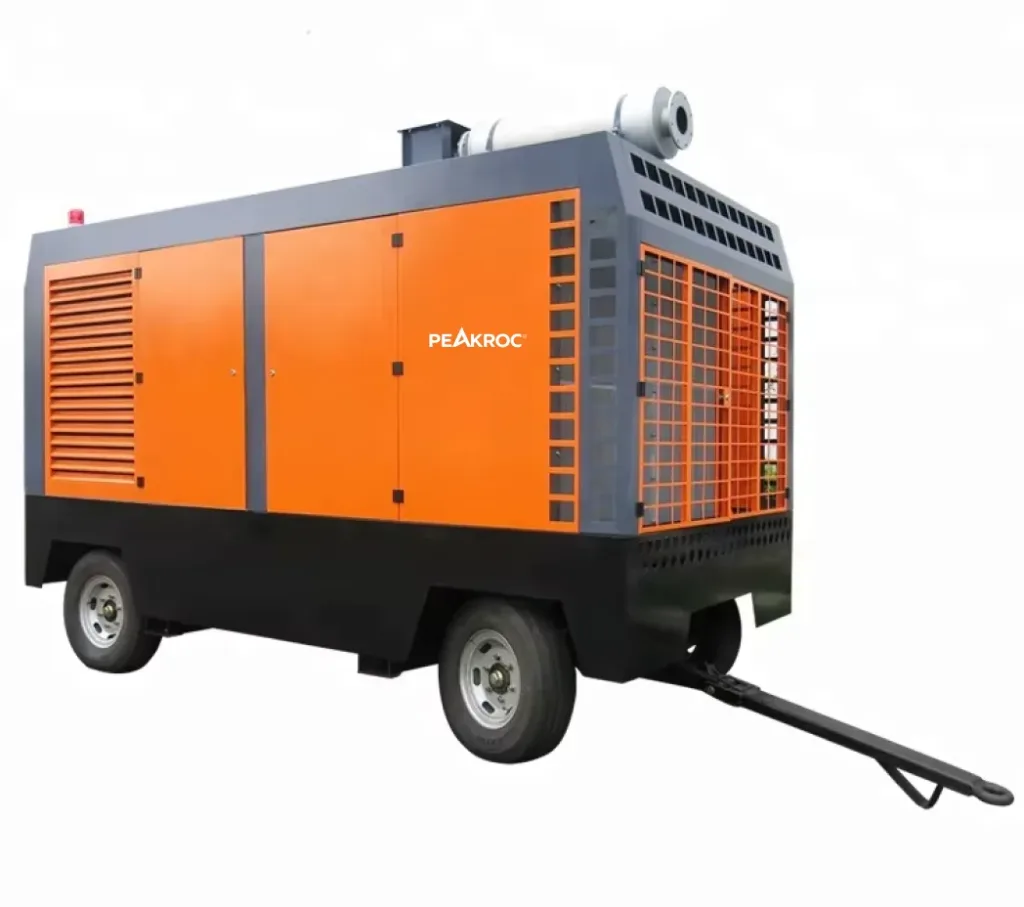
- Peakroc®’s portable compressor range is subjected to pressure/flow, noise/vibration and final QC testing before delivery; project-specific FAT requirements can be agreed before production is released for shipment.
- A practical example is the Peakroc® 20 m³/min, 13 bar PRMD-2013: units supplied for a high-altitude mining project were factory-tested under simulated low-atmospheric-pressure conditions before shipment because normal sea-level testing alone did not address the customer’s actual operating risk.
- The buyer should receive recorded results—not only a test video—including serial numbers, test conditions, calibrated instruments, measured pressure/flow, temperatures, safety checks, options, deviations and final sign-off.
A portable compressor can look perfect during a factory walk-around and still create problems after arriving at a mine, drilling site or construction project.
The machine may reach rated pressure but fail to deliver the expected airflow. It may operate normally for ten minutes but overheat after reaching thermal equilibrium. A cold-weather package may appear on the purchase order but have an untested heater. A road-towable configuration may leave the factory with the wrong coupling or missing accessories.
That is why a Factory Acceptance Test should answer a specific question:
Does this exact compressor, in its ordered configuration, meet the agreed performance and functional requirements before the buyer accepts shipment?
A useful FAT therefore follows the machine from identification through full-load operation, safety functions and final documentation.
FAT Is Different From a Quick Pre-Delivery Inspection
A routine pre-delivery inspection and a contractual FAT overlap, but they are not exactly the same thing.
A normal factory QC process confirms that the finished compressor has been assembled correctly, operates normally and is ready for delivery.
A buyer-defined FAT goes further.
It ties the test directly to the purchase order or technical specification and establishes in advance:
what will be tested, how it will be measured, what conditions apply and what constitutes acceptance.
ISO 1217 is especially relevant here. It specifies methods for acceptance testing of displacement compressors, including measurement of volume flow rate and power requirements, and requires the operating and testing conditions for a full performance test to be agreed between manufacturer and purchaser.
The standard also requires the compressor to reach sufficiently stable operating conditions before performance readings are treated as valid.
This leads to an important distinction:
FAT ≠ Start Engine → Build Pressure → Stop Machine
A meaningful FAT should prove performance after the compressor has stabilized under a representative load.
Site Acceptance Testing, or SAT, comes later.
FAT verifies the machine before shipment.
SAT verifies that the delivered compressor, hoses, tools, installation and actual site conditions work together after arrival.
Build the FAT From the Purchase Specification
The strongest FAT checklist begins before the compressor reaches the test bay.
Start with the purchase order.
Confirm the exact model, serial number, engine configuration, rated FAD, rated working pressure, chassis type and ordered accessories.
For example, if the contract specifies:
20 m³/min (710 CFM) at 13 bar (189 PSI)
the FAT should verify that operating point.
Testing only that the machine can momentarily reach 13 bar is not enough.
Pressure and flow have to exist together.
The buyer and supplier should also agree on the test environment and method because inlet temperature, atmospheric pressure and other conditions affect compressor performance.
This becomes particularly important at altitude.
A compressor purchased for a 4,000 m mine may need a different validation strategy from the same machine purchased for sea-level construction work.
A practical FAT can then be organized around five groups:
| FAT Area | What Should Be Verified |
|---|---|
| Identity & configuration | Model, serial numbers, engine, airend, chassis, options and accessories |
| Performance | FAD/CFM, working pressure, load/unload response and operating stability |
| Engine & thermal condition | RPM, oil pressure, coolant temperature, compressor temperature and charging |
| Safety & integrity | Emergency stop, alarms, shutdowns, leaks, blowdown and guards |
| Delivery documentation | Test report, photos/video, manuals, spare parts, certificates and deviations |
The exact acceptance tolerances should come from the contract, relevant test method and manufacturer’s guaranteed performance—not from a generic number copied from another compressor.
Test the Compressor Under Real Load
The most important part of the FAT is the operating test.
Begin with a normal startup inspection.
Verify that the engine starts correctly, controller boots normally and no abnormal alarm is active.
During warm-up, technicians should observe engine oil pressure, charging voltage, coolant behaviour and compressor-system pressure.
Then apply load progressively.
At rated operation, the FAT should establish whether the compressor can maintain its guaranteed pressure and airflow simultaneously.
For a portable diesel screw compressor, useful recorded parameters typically include:
discharge pressure, measured FAD, engine RPM, coolant temperature, compressor discharge/oil temperature and relevant controller readings.
The machine should run long enough to reach a stable condition.
This matters because some problems only become visible after heat has accumulated.
A cooler partially blocked internally, a fan-control problem or inadequate thermal margin may not appear during a short demonstration.
DOE’s compressor performance procedure, which incorporates ISO 1217 methods, similarly requires measurement of parameters including volume flow, inlet/discharge pressure and temperature under defined test conditions.
Do Not Confuse Maximum Pressure With Rated Performance
This is one of the most common procurement mistakes.
Suppose the datasheet says:
20 m³/min @ 13 bar
During FAT, the outlet is closed until the gauge reaches 13 bar.
That proves the compressor can build pressure.
It does not prove it can deliver 20 m³/min while maintaining 13 bar.
The real guarantee point is:
FAD + Pressure at the Same Operating Condition
For this reason, Peakroc’s Compressor Finder lists air delivery and working pressure together when matching compressors to applications.
Check Controls, Safety and Mechanical Integrity
Performance testing tells the buyer whether the compressor can produce air.
Functional testing tells the buyer whether it behaves correctly while producing it.
During loading and unloading, confirm that the inlet/control system responds normally and pressure remains stable rather than hunting or repeatedly overshooting.
The shutdown sequence should also be observed.
On an oil-injected screw compressor, pressure should release according to the designed blowdown sequence rather than remaining trapped unexpectedly.
Leaks deserve attention throughout the test.
Inspect:
fuel, coolant, engine oil, compressor lubricant and compressed-air connections.
A machine should not be accepted simply because a leak is small enough to wipe clean before loading into a container.
Safety devices should also be tested according to the approved factory procedure.
This normally includes the emergency stop and relevant alarms or protective shutdown logic.
Do not deliberately create destructive conditions merely to prove that protection exists. Where a protection function is verified by simulation or controller input, the FAT report should state the method used.
Noise can also form part of the contractual FAT.
ISO 2151 provides a standardized method for measuring and declaring compressor noise under specified mounting, loading and operating conditions and explicitly covers portable and skid-mounted compressors.
Therefore, if a purchase specification says:
Noise ≤ X dB(A)
it should also state the measurement method and conditions.
A dB number without test distance, loading condition and methodology is difficult to compare reliably.
Vibration should be approached similarly.
The purpose of a factory check is not merely to record a number but to identify abnormal mechanical behaviour—loose mounts, fan imbalance, driveline problems, panel resonance or unexpected movement—that could become a service problem later.
Portable Compressors Need a Chassis and Configuration Inspection Too
A stationary compressor FAT can focus heavily on the compression package.
A portable compressor has another system attached to it:
the transport platform.
Before shipment, check the actual configuration against the order.
For a towable machine this may include tires, wheel fasteners, suspension, tow eye, parking brake or road-brake equipment where supplied, lights, safety chains and mudguards.
For a skid-mounted unit, inspect lifting and tie-down points.
Also confirm:
- compressed-air outlet size and quantity;
- fuel-tank configuration;
- battery installation;
- doors, locks and service access;
- drains and low points;
- gauges and controller language;
- supplied hoses, tools and spare parts;
- optional aftercooler, moisture separator, heater or special filtration package.
Destination-road compliance should be treated separately from general compressor performance because registration, braking and lighting requirements vary by market.
The factory should verify what was ordered.
The importer or purchaser should verify that the specified transport configuration is suitable for the destination’s legal requirements.
Peakroc EEAT Case: FAT Changed Because the Jobsite Was at 3,850 m
A Peakroc high-altitude mining project provides a good example of why FAT should follow the customer’s operating risk rather than a generic checklist.
The project used three PRMD-2013 portable diesel compressors for drilling at approximately 3,850 m elevation.
A normal sea-level factory run could verify basic operation, but it would not directly address the project’s biggest concern:
Would the compressor maintain the required performance in thin air?
Peakroc therefore carried out pre-delivery testing under simulated low-atmospheric-pressure conditions before the machines were shipped.
The project specification also included cold-start considerations, so engine block heaters were added for winter morning conditions reaching approximately −5°C.
The important FAT lesson is not the exact altitude.
It is the process:
Identify the customer’s highest operational risk → add a test or configuration check that specifically addresses that risk before shipment.
For a desert project, the concern may be cooling and filtration.
For Siberian winter operation, the FAT may need to verify heaters, battery condition and low-temperature configuration.
For pipeline work, the buyer may focus on aftercooling, moisture separation and sustained airflow.
For a noise-restricted urban project, acoustic verification may become a contractual witness point.
A generic FAT checklist is only the starting point.
A good FAT is application-specific.
Peakroc’s Wuxi production facility follows the same principle at the quality-system level. The company’s published QA process includes pressure and flow tests, noise and vibration checks, efficiency evaluation and final QC verification before delivery.
What Should the Buyer Receive After FAT?
The FAT is not complete when the engine stops.
The evidence matters.
A useful final FAT package should identify the exact compressor and preserve the measured results so the buyer can compare them with the purchase specification later.
At minimum, record:
- machine model and compressor/engine serial numbers;
- FAT date, location and responsible personnel;
- test instruments and calibration status;
- ambient/test conditions;
- rated and measured FAD/CFM and pressure;
- engine RPM and major operating temperatures;
- control, alarm and emergency-stop results;
- leakage, noise/vibration and visual-inspection results;
- ordered options and supplied accessories;
- deviations, corrective actions and final acceptance signatures.
Photos and video are useful supporting evidence.
They should not replace recorded measurements.
A video showing a pressure gauge at 13 bar cannot prove a 710 CFM guarantee unless airflow was actually measured.
Likewise, a photo of an installed block heater does not prove it was electrically tested.
For international purchases, documentation is especially valuable because fixing a missing option at the factory may take hours, while fixing it after sea freight and customs clearance can take weeks.
Final Recommendation
A portable compressor Factory Acceptance Test should answer one question:
Does this exact machine meet the agreed specification before it leaves the factory?
Begin with configuration and serial-number verification.
Then run the compressor under representative load until conditions stabilize.
Verify FAD and working pressure together, not pressure alone.
Monitor engine and compressor temperatures, RPM and control response.
Check safety functions, shutdown behaviour and fluid/air leakage.
Inspect the chassis and every ordered option.
Finally, document the results and resolve deviations before shipping authorization.
The practical FAT sequence is:
Specification → Configuration Check → Startup → Full-Load Stabilization → FAD & Pressure → Thermal/Engine Checks → Controls & Safety → Leaks/Noise/Vibration → Chassis & Options → Documentation → Release for Shipment
ISO 1217 gives buyers and manufacturers a recognized basis for compressor performance acceptance testing, while project-specific risks determine what additional tests should be added.
The strongest FAT is therefore not the longest checklist.
It is the checklist that verifies the performance and configuration the customer will actually depend on at the jobsite.
FAQ
What is a portable compressor Factory Acceptance Test?
A FAT is a pre-shipment verification performed at the manufacturer to confirm that the specific compressor meets agreed purchase specifications for configuration, performance, controls, safety and documentation.
Should FAD be measured during FAT?
If airflow performance is a contractual requirement, FAD should be verified using an agreed test method. Pressure alone cannot demonstrate the compressor’s rated air-delivery performance.
How long should a compressor run during FAT?
There is no universal time for every model. The compressor should operate long enough to reach the steady conditions required by the agreed test procedure and to verify stable performance and temperature behaviour.
What is the difference between FAT and SAT?
FAT is performed at the factory before shipment. SAT is conducted after delivery to confirm that the compressor and the actual site system work correctly together.
Should the buyer witness the FAT?
For customized, high-value or application-critical compressors, witnessing the FAT directly or by live video can be useful. The contractual FAT report and measured data remain more important than visual observation alone.
Author

Mark Chen – Senior Mechanical Engineer, Peakroc®
Mark Chen is a senior mechanical engineer at Peakroc®, specializing in compressed air systems and drilling equipment for mining and construction applications. With over 15 years of field experience, he has led multiple projects on optimizing air delivery efficiency, equipment durability, and energy consumption.