
Key Takeaways
- Oil carryover means more compressor lubricant than expected is leaving an oil-injected screw compressor with the compressed air. A small residual oil level is inherent to this compressor type; the acceptable level depends on machine design and application.
- A failed separator element is only one possible cause. Oil overfill, blocked scavenge lines, incorrect lubricant, foaming, abnormal vessel pressure, overheating, and installation errors can create similar symptoms.
- High separator differential pressure and high oil carryover are different faults. High differential pressure mainly indicates restriction, while a damaged or bypassed element can pass oil without producing unusually high differential pressure.
- If a separator has just been replaced but the compressor still uses excessive oil, inspect the scavenge line, return orifice, check valve, oil level, lubricant condition, and minimum-pressure system before replacing the element again.
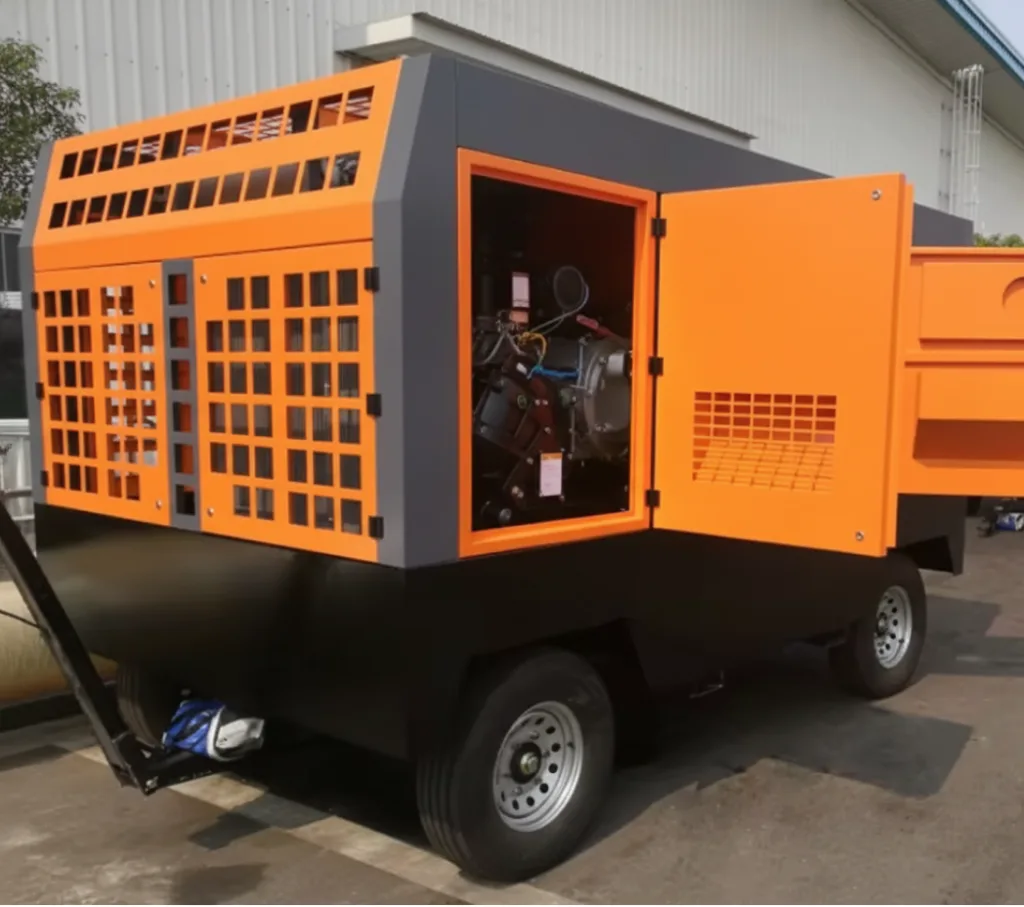
- Standard and medium-pressure fleets can review the Peakroc® portable diesel screw compressor range, while demanding drilling fleets should include separator condition and oil-system inspection in the maintenance plan for high-pressure machines such as the 39 m³/min, 25 bar portable diesel compressor.
- Never remove an oil separator cover, scavenge line, filter, or fitting until the compressor is stopped, isolated, cooled as required, and fully depressurized according to its service manual.
Modern air/oil separator elements are designed to achieve two objectives at once: very low residual oil and low pressure loss. As an engineering example, separator-element manufacturers publish residual-oil figures below roughly 2–3 mg/m³ and initial pressure drops around 0.25–0.3 bar for certain designs. Those values are component-specific examples, not universal limits for every portable compressor.
How Oil Separation Works in a Portable Screw Compressor
In an oil-injected rotary screw compressor, lubricant enters the compression element for several reasons. It lubricates moving parts, removes compression heat, helps seal clearances between the rotors and housing, and carries contamination toward the oil filtration circuit.
The air leaving the airend therefore contains a large amount of oil.
It first enters the separator vessel, where much of the liquid oil is removed through changes in velocity, direction, and centrifugal or inertial separation. The remaining fine aerosol then passes through the air/oil separator element.
Inside the separator media, small oil droplets coalesce into larger droplets. These collect near the bottom of the element and are returned to the compressor oil circuit through the scavenge line, also called the oil return or drain-back line. Technical separator documentation describes this same sequence: oil mist becomes droplets, collects, and is returned to the compressor element.
That means the separator system is not one component.
It is a system consisting of the vessel, separator element, scavenge line, return orifice, non-return valve, oil level, lubricant, minimum-pressure system, and operating conditions.
This is why replacing only the separator element does not always solve oil carryover.
What Counts as Oil Carryover?
A thin trace of lubricant in discharge air is different from abnormal carryover.
Oil-injected screw compressors are designed to remove almost all lubricant before air leaves the separator, but they do not inherently produce oil-free compressed air. Actual residual oil depends on the separator design, lubricant, temperature, pressure, flow, maintenance condition, and downstream air treatment.
Abnormal carryover is more likely when operators notice a combination of:
- Compressor oil level falling faster than normal
- Visible oil mist or droplets at the discharge
- Wet or oily downstream hoses
- Oil collecting in aftercoolers or filters
- Contamination of blasting, coating, cable-blowing, or process equipment
- More frequent downstream coalescing-filter replacement
- Oil consumption increasing without an external leak
Peakroc’s existing portable screw compressor troubleshooting guide also treats oil in the discharge air as a system fault that should be traced through the separator, oil level, scavenge circuit, and operating pressure rather than assuming one component has failed.
The Most Common Causes of Oil Carryover
| Possible cause | Typical clue | Why it creates carryover |
|---|---|---|
| Worn or damaged separator element | Oil consumption rises with service age | Fine oil aerosol is no longer separated effectively |
| Blocked scavenge line | New separator does not solve the problem | Collected oil cannot return to the airend |
| Oil overfill | Problem appears after service or topping up | Excess liquid oil overloads the separation system |
| Wrong or mixed lubricant | Foaming, abnormal oil appearance, temperature change | Oil properties no longer match separator design |
| Low vessel pressure | Carryover occurs at unusually low operating pressure | Separation and oil-return conditions become unstable |
| High operating temperature | Oil becomes thinner or more volatile | More fine aerosol or vapour enters the air stream |
| Separator installation problem | Problem begins immediately after replacement | Seal, element, return tube, or fitment may be incorrect |
| Heavy contamination | Increasing pressure drop and dirty oil | Separator media and return passages load prematurely |
The reference article also identifies separator condition, return-line restrictions, low separator-vessel pressure, incorrect oil viscosity, foaming, and minimum-pressure valve faults as recurring causes encountered during service work.
Separator Differential Pressure: What It Really Tells You
Differential pressure is the pressure difference between the dirty side and clean side of the separator element.
As contamination builds within the media, resistance increases. The compressor then has to maintain additional pressure inside the separator vessel simply to push air through the element.
This matters for both performance and operating cost. Industry technical literature confirms that increased separator pressure drop increases the work required from the compressor; one OEM technical note gives the illustrative example that an additional 1 bar of separator pressure drop can raise power consumption by about 7% in the referenced compressor system. This percentage should not be transferred directly to every portable diesel machine, but the relationship is valid: unnecessary separator restriction wastes power.
However, differential pressure is not a direct oil-content meter.
Consider three conditions:
| Separator condition | Differential pressure | Possible oil carryover |
|---|---|---|
| Clean, healthy element | Low/normal | Low/normal |
| Dirty or plugged element | High | May be normal or elevated |
| Torn, bypassed, incorrectly sealed element | Normal or even unusually low | Potentially high |
This distinction is important.
If technicians see high carryover but normal differential pressure, they should not conclude that the separator must be healthy. A damaged element, gasket leak, scavenge fault, or overfilled vessel may still be responsible.
Likewise, high differential pressure alone does not prove that the element is passing excessive oil.
Why the Scavenge Line Causes So Many Misdiagnoses
The scavenge line removes oil that has collected after coalescing.
It is normally a relatively small line, so it can be affected by sludge, varnish, contamination, a blocked orifice, damaged non-return valve, incorrect routing, or improper positioning after separator service.
If oil reaches the bottom of the separator but cannot leave, the collected liquid level rises until the moving air can pick it up again.
The result looks exactly like separator failure.
The reference article describes service cases in which a kinked return line or lubricant-derived sludge restricted the return path and increased oil discharge.
Peakroc’s own field troubleshooting guidance describes the same diagnostic pattern: persistent oil carryover after separator replacement can be caused by a blocked scavenge line or its check valve rather than by the new separator element itself.
A scavenge-line assembly may include not only tubing but also an orifice, non-return valve, and seals, which is why simply blowing air through the visible pipe may not verify that the complete return circuit is operating correctly.
Oil Overfill: The Simple Cause That Is Easy to Miss
Oil carryover that starts immediately after servicing should make oil level one of the first checks.
Overfilling reduces the free volume available inside the separator vessel and exposes the separation system to more liquid oil than intended.
The machine may then discharge oil even though the separator element is relatively new.
Do not remove oil based on a random sight-glass observation. Oil level can vary depending on:
- Whether the compressor is hot or cold
- Whether it has just been shut down
- Whether internal pressure has fully released
- Machine inclination
- How much oil remains in the cooler and piping
Use the exact oil-level inspection procedure in the machine manual.
A maintenance technician who repeatedly tops the oil to the very top of a sight glass can unintentionally create the same problem they are trying to prevent.
Wrong Lubricant, Mixed Oils, and Foaming
Rotary screw compressor lubricant has to do much more than lubricate bearings.
Its viscosity, oxidation resistance, anti-foam behaviour, water separation, thermal stability, and compatibility with seals and separator media affect the complete compression cycle. Official compressor-lubricant guidance emphasises lubrication, cooling, sealing, and contaminant transport as simultaneous functions of the fluid.
Foaming is particularly relevant to oil carryover.
Stable foam creates a large oil-air interface and can overwhelm normal separation behaviour. Possible triggers include incompatible lubricants, mixing different chemistries, contamination, water ingress, degraded oil, or an unsuitable viscosity.
If oil carryover appears shortly after an oil change, investigate the lubricant before condemning the separator.
Check the service record:
What oil was installed? Was the previous oil completely drained? Were two lubricant types mixed? Was the correct quantity added?
For portable compressors working in drilling, mining, and dusty construction environments, lubricant contamination and heat can accelerate both oil degradation and separator loading. Peakroc’s portable compressor overheating troubleshooting guide explains how oil condition, cooler cleanliness, filtration, and operating temperature interact in field service.
Low Vessel Pressure and the Minimum-Pressure Valve
The separator vessel does more than hold the separator element.
It also maintains the pressure needed for the compressor oil circuit and separation process. Rotary screw compressor technical documentation identifies the separator vessel and minimum-pressure valve as part of the system used to maintain lubrication pressure.
If the minimum-pressure valve opens too early, leaks, or fails to maintain the required vessel pressure, several things can happen:
Oil circulation may become unstable, the pressure differential driving the scavenge system can change, and oil separation can become less effective.
This is why a high-pressure portable compressor should not be operated indefinitely at an arbitrarily low pressure simply because the outlet regulator can be turned down.
The compressor should be operated inside its specified control range.
If oil carryover occurs mainly during startup, unloading, very low-pressure operation, or load transitions, the minimum-pressure system deserves closer inspection.
A Better Troubleshooting Sequence
When oil appears in the discharge air, avoid replacing parts at random.
Use this order:
- Confirm the symptom. Determine whether the issue is actual compressor-oil consumption, an external leak, accumulated oil already inside downstream piping, or new oil entering the air stream.
- Check oil level correctly. Verify the machine using the specified shutdown and depressurisation procedure.
- Review the lubricant. Confirm product specification, age, contamination, foaming, temperature, and whether incompatible fluids were mixed.
- Inspect separator condition and differential pressure. Compare the reading with the exact machine’s service limit rather than using a universal pressure-drop number.
- Inspect the complete scavenge circuit. Check the tube, pickup position, orifice, check valve, seals, and return path.
- Check operating conditions. Verify vessel pressure, minimum-pressure valve function, operating temperature, intake contamination, and whether the fault began after recent maintenance.
Only after these checks should the separator element itself be treated as the confirmed root cause.
This diagnostic order avoids one of the most common repair patterns: replacing a separator, seeing no improvement, and replacing the separator again.
Three Field Patterns That Improve Diagnosis
Case 1: Oil Carryover After a Separator Change
A compressor begins passing oil soon after an element replacement.
The immediate conclusion is often “the new separator is defective.”
A better investigation checks whether the scavenge tube was correctly positioned, whether the return orifice or non-return valve is blocked, whether the gasket is seated correctly, and whether the compressor was overfilled during service.
Service experience documented in the reference article specifically identifies return-line kinks and restrictions as causes of increased oil discharge.
Case 2: High Differential Pressure but Little Visible Oil
The compressor shows increasing pressure drop across the separator but no dramatic oil mist at the outlet.
This is entirely possible.
Separator-element technical data treat residual oil and pressure drop as independent design parameters. A heavily loaded element can therefore create excessive restriction before it loses its ability to coalesce oil.
The risk here is not only air quality. It is wasted compressor power, higher internal pressure, possible capacity loss, and additional thermal load.
Case 3: Chronic Oil Consumption With a “Good” Separator
The separator is within its expected service period and differential pressure appears normal, yet oil needs frequent topping up.
Check external leaks first.
If the machine is dry externally, investigate oil overfill history, operating temperature, scavenge return, lubricant foaming, minimum vessel pressure, and possible element bypass before deciding that separator service life alone explains the problem.
This reflects the broader lesson from both the reference article and Peakroc field troubleshooting material: oil carryover is a system diagnosis, not a separator-only diagnosis.
When Should the Oil Separator Be Replaced?
There is no responsible universal replacement interval.
Different compressor families publish separator-service intervals ranging from around 2,000 hours to substantially longer intervals such as 4,000, 6,000, or 8,000 hours depending on machine design, lubricant, element construction, operating conditions, and maintenance programme. Official maintenance kits from different oil-flooded compressor families demonstrate this variation clearly.
For a portable diesel compressor, replacement should be based on the machine manual plus actual operating condition.
Replace or investigate the separator when:
- The specified service interval is reached
- Differential pressure exceeds the machine limit
- Oil carryover is confirmed and other causes have been excluded
- The element is physically damaged
- The element was contaminated by incorrect oil or severe overheating
- The vessel has been opened and the service procedure requires replacement
Remote drilling and mining machines may need shorter practical inspection intervals because dust, heat, long loaded hours, and inconsistent fuel or maintenance conditions accelerate contamination.
For broader service planning, Peakroc’s maintenance resources and after-sales support can be used to prepare machine-specific filter, lubricant, separator, and critical-spare schedules.
Replacing the Separator Correctly
Separator replacement involves a pressure vessel and must be treated as a controlled service procedure.
The engine must be stopped and prevented from restarting. Internal pressure must be completely released and verified before the vessel is opened.
During replacement, inspect the vessel, separator seating surface, seals, scavenge pickup, check valve, and return line—not only the old element.
Use the separator specified for the exact compressor model and pressure class. Separator construction affects both oil removal and pressure loss; technical component literature shows that flow capacity, residual-oil performance, operating temperature, and pressure drop are engineered characteristics rather than generic dimensions.
After service, confirm:
- Correct compressor oil level
- No leakage around the separator cover
- Normal vessel pressure
- Normal separator differential pressure
- Stable scavenge return
- No abnormal foaming
- Oil consumption over the following operating hours
Do not judge the repair from five minutes of idling. Oil already accumulated in aftercoolers, hoses, and downstream piping may continue appearing for some time after the root cause has been corrected.
Preventing Separator Failure on Portable Compressors
Portable compressors work in harsher environments than many fixed plant systems.
Dust, vibration, high ambient temperature, long loaded shifts, irregular maintenance, and rough transport all affect separator life.
The most effective preventive strategy is simple: maintain the entire oil and air circuit rather than treating the separator as an isolated consumable.
Track oil level and consumption, use the specified lubricant, keep intake filtration and coolers clean, log operating temperature, monitor differential pressure where available, inspect the scavenge circuit during separator service, and investigate sudden changes immediately.
A gradual increase in oil use can be cheaper to diagnose today than a saturated downstream system, contaminated blast surface, or shutdown on a remote site tomorrow.
Final Recommendation
Visible oil at the air outlet does not automatically mean the separator element has failed.
Start with the simple causes: correct oil level, lubricant condition, external leaks, operating temperature, and maintenance history.
Then separate the problem into two diagnostic paths:
High differential pressure points mainly toward separator restriction or contamination.
High oil carryover points toward separation efficiency, scavenge return, oil level, foaming, element installation, operating pressure, or physical separator damage.
Sometimes both occur together. Sometimes they do not.
The most expensive mistake is replacing the separator repeatedly without checking why the separated oil is not returning to the compressor.
Treat the air/oil separator as a complete system, and the diagnosis becomes much faster.
FAQ
What causes oil carryover in a portable screw compressor?
Common causes include a damaged separator element, blocked scavenge line, excessive oil level, incorrect lubricant, foaming, abnormal operating temperature, low separator-vessel pressure, minimum-pressure valve problems, and installation errors.
Does high separator differential pressure mean the separator is passing oil?
Not necessarily. High differential pressure mainly indicates increasing airflow resistance through the element. A restricted separator may still separate oil effectively, while a torn or bypassed separator can produce high carryover without high differential pressure.
Can too much compressor oil cause oil carryover?
Yes. Overfilling can overload the separation system and allow more liquid oil to enter the discharge stream.
Why does a new oil separator still pass oil?
The separator may not be the root cause. Check the scavenge line, return orifice, check valve, separator seal and installation, oil level, lubricant foaming, vessel pressure, and minimum-pressure valve.
Can the wrong compressor oil damage the separator?
Incorrect or incompatible lubricant can alter viscosity, foaming behaviour, thermal stability, and contamination characteristics. These changes can reduce separation performance and shorten separator life.
How often should an air/oil separator be replaced?
Use the interval specified for the exact compressor model. Published maintenance programmes vary widely, so a universal 3,000-, 4,000-, or 8,000-hour rule should not be applied to every portable compressor.
Why is my compressor using oil but there is no external leak?
Possible causes include oil carryover, scavenge-line failure, separator bypass, excessive temperature, foaming, or incorrect oil level. Confirm consumption over a measured operating period before replacing parts.
Can I clean and reuse an oil separator element?
Normally, a separator element is treated as a replacement component rather than a washable filter. Follow the compressor manufacturer’s specific service instructions.
Author

Mark Chen – Senior Mechanical Engineer, Peakroc®
Mark Chen is a senior mechanical engineer at Peakroc®, specializing in compressed air systems and drilling equipment for mining and construction applications. With over 15 years of field experience, he has led multiple projects on optimizing air delivery efficiency, equipment durability, and energy consumption.