7 Bar vs 10 Bar vs 13 Bar Portable Diesel Screw Air Compressors: How to Compare FAD, Fuel Consumption, Tool Pressure, Hose Loss, and Application Fit for Construction, Sandblasting, Cable Blowing, Quarrying, and Shallow DTH Drilling
7 bar is approximately 102 PSI, 10 bar is approximately 145 PSI, and 13 bar is approximately 189 PSI.
Higher pressure does not automatically mean higher productivity. The connected tool must be able to use the additional pressure.
FAD must be compared at the required working pressure. A variable-pressure compressor normally supplies more airflow at a lower pressure setting and less airflow near its maximum pressure.
A 7 bar compressor is commonly suitable for breakers, pneumatic tools, cleaning, road maintenance, and selected blasting work.
A 10 bar compressor provides additional pressure reserve for heavy sandblasting, long hose runs, quarry support, and selected drilling applications.
A 13 bar compressor is more appropriate for cable blowing, demanding surface preparation, anchoring, and selected shallow DTH drilling systems.
Compressor pressure at the outlet is not the same as pressure at the tool. Hoses, couplings, valves, filters, dryers, and leaks all create pressure loss.
For DTH drilling, the hammer manufacturer’s pressure and airflow chart must take priority over general pressure-class recommendations.
Selecting between a 7, 10, and 13 bar portable compressor appears straightforward until airflow, hose length, tool demand, and operating cost are considered.
A buyer may assume that the 13 bar machine is automatically the best because it offers the highest pressure. In practice, a 13 bar compressor can be unnecessarily expensive for a road crew operating breakers at 6–7 bar. At the other extreme, a 7 bar machine may provide sufficient nominal CFM but still fail to maintain the pressure required by a cable-blowing system or shallow drilling tool.
Peakroc® offers portable diesel screw air compressors across standard-, medium-, and high-pressure classes. The correct machine should be selected according to the pressure and airflow required at the actual point of use—not only the maximum bar or CFM shown in the product title.
What Do 7 Bar, 10 Bar, and 13 Bar Mean?
The bar rating identifies the compressor’s working pressure. It indicates how much pressure the machine is designed to maintain while delivering its stated airflow.
These application directions are not universal limits. One sandblasting nozzle may operate at 7 bar, while another setup needs close to 10 bar because of its nozzle size, hose length, and required production rate.
Atlas Copco’s variable-pressure application guidance gives a similar progression: approximately 7 bar for handheld tools, around 8.5–10 bar for abrasive blasting and drilling, and up to 12–14 bar for shotcreting or cable blowing. Kaeser also offers portable compressor variants at 7, 10, 13, and 15 bar for applications ranging from pneumatic tools to blasting and cable installation.
Pressure and FAD Perform Different Jobs
Pressure and airflow are related, but they are not interchangeable.
Pressure enables the air to overcome resistance and operate the tool. It affects impact energy, nozzle velocity, cable-blowing force, and the ability to overcome losses through hoses and equipment.
FAD, or Free Air Delivery, indicates how much usable air the compressor supplies under defined conditions. It determines whether one or several tools can operate continuously without pressure collapsing.
A compressor with sufficient pressure but inadequate FAD may initially bring a tool up to pressure, then lose performance as soon as continuous demand begins.
A compressor with high FAD but insufficient pressure may move a large volume of air but still fail to operate equipment that requires a higher inlet pressure.
This distinction is especially important when comparing machines with different pressure ratings.
Why Available FAD Often Falls as Pressure Rises
Compressing air to a higher pressure requires more work. When the same compressor package operates across an adjustable pressure range, its controller generally provides more airflow at lower pressure and less airflow near the maximum setting.
Atlas Copco’s B-Air 185-12 provides a clear published example. Its pressure range is 5–12 bar, while its stated airflow changes from approximately 5.4 to 3.7 m³/min across that range. Atlas Copco describes this as one advantage of variable-pressure control: the compressor can provide additional flow when the job requires lower pressure.
Therefore, buyers should not ask only:
What is the maximum pressure?
They should ask:
What FAD does this compressor deliver at 7, 10, or 13 bar?
A quotation that lists maximum CFM at one pressure and maximum bar at another pressure is incomplete unless the complete pressure-flow relationship is provided.
Comparing Similar 10 Bar and 13 Bar Peakroc® Models
Peakroc’s published product data also illustrates the additional power associated with higher-pressure duty.
This comparison does not establish the exact fuel-consumption difference because fuel burn also depends on engine efficiency, control strategy, load factor, ambient conditions, and operating speed.
It does demonstrate an important engineering principle:
Maintaining the same airflow at higher pressure normally requires more engine power and a compressor system designed for the higher load.
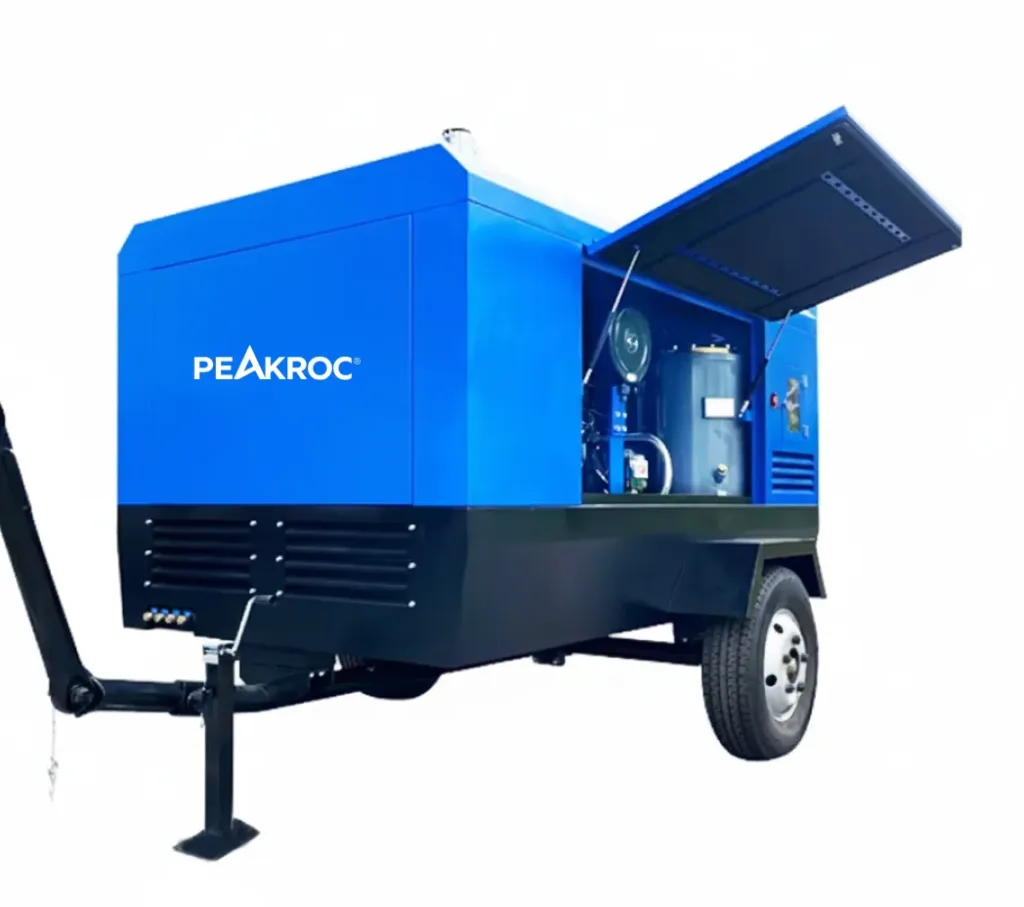
10 m³/min, 13 bar portable diesel compressor
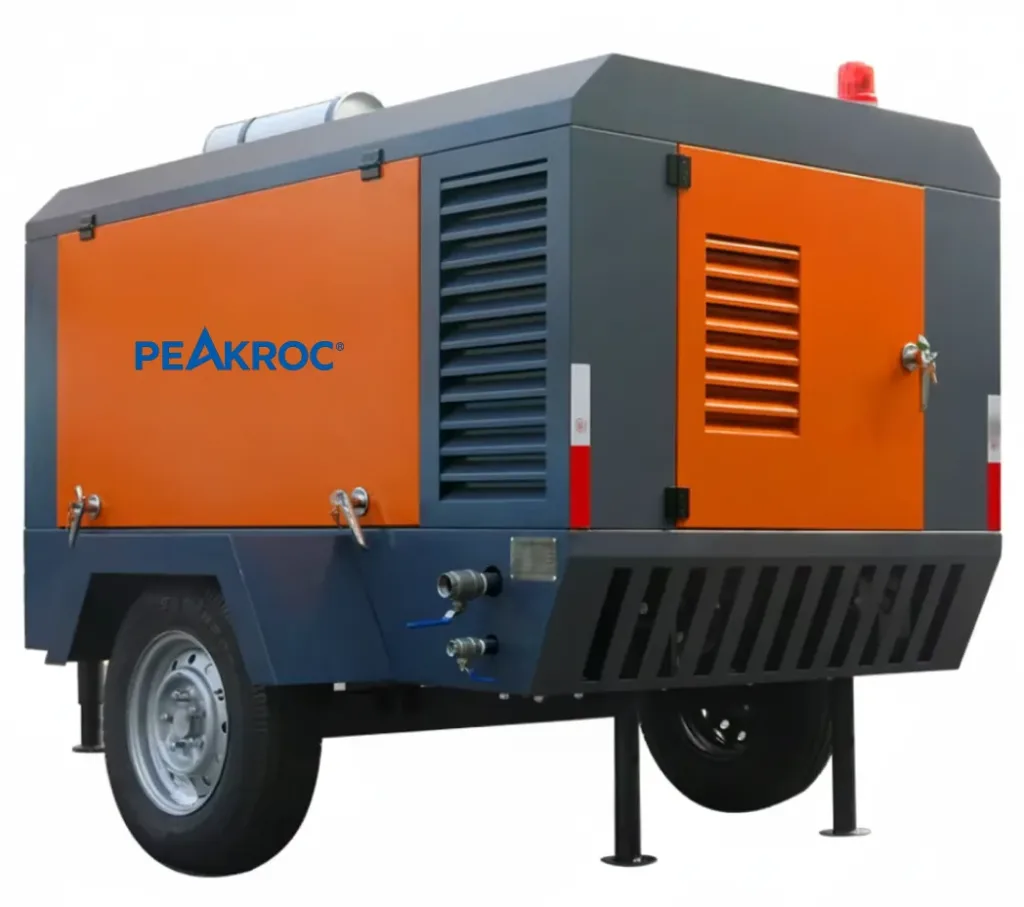
10 m³/min, 10 bar portable diesel compressor
Pressure at the Compressor Is Not Pressure at the Tool
A compressor may display 7, 10, or 13 bar at its outlet, but the tool receives less pressure after air passes through the distribution system.
Pressure can be lost through:
Long or undersized hoses
Small quick couplings
Multiple bends and manifolds
Partially open valves
Dirty filters or separators
Aftercoolers and dryers
Leaking connections
Tool lubricators and regulators
A practical starting relationship is:
Required compressor pressure =
Required tool inlet pressure
+ distribution pressure loss
+ controlled operating reserve
The reserve should be based on the actual system, not an arbitrary decision to purchase a much higher-pressure machine.
The U.S. Department of Energy recommends correcting system restrictions before increasing compressor pressure. Its compressed-air guidance explains that pressure drop through hoses, filters, dryers, and distribution components reduces point-of-use performance, while unnecessarily raising discharge pressure increases energy consumption.
For mobile systems, pressure gauges at both the compressor outlet and near the tool can help identify whether poor performance is caused by the compressor or the hose arrangement.
When a 7 Bar Portable Compressor Is the Better Choice
A 7 bar compressor is usually the most economical direction when the connected tools are designed to operate around 6–7 bar and the hose system does not create excessive pressure loss.
Construction Tools and Breakers
Common 7 bar applications include:
Pneumatic breakers
Rock drills
Chipping hammers
Impact wrenches
Air saws
Grinders
Road-maintenance tools
Cleaning and blowing
Atlas Copco identifies approximately 7 bar as a suitable setting for handheld pneumatic tools. Kaeser’s Mobilair M13 provides 1.2 m³/min at 7 bar and is promoted for air hammers, drills, saws, grinders, wrenches, impact moles, and sewer robots.
A 5 m³/min, 7 bar Peakroc® portable compressor may suit a mobile maintenance crew, one large pneumatic tool, or a selected single-nozzle blasting setup, provided the combined air demand remains below the machine’s verified FAD.
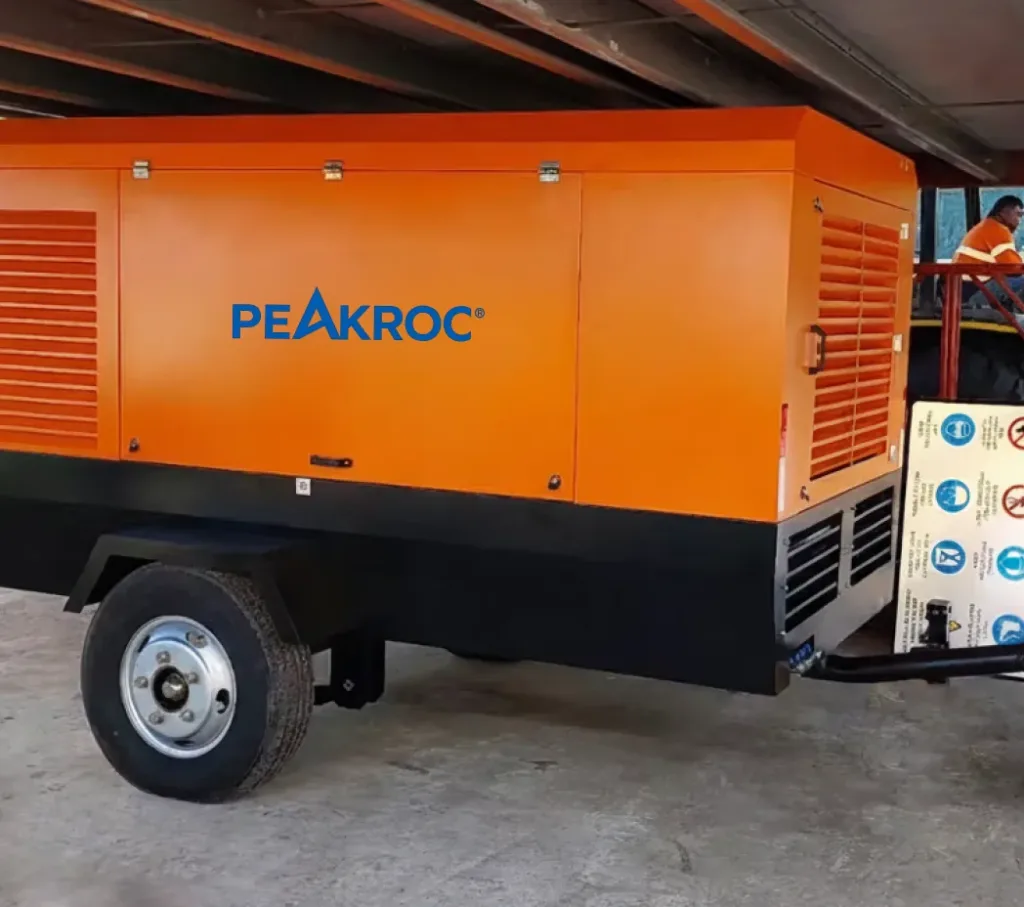
5 m³/min, 7 bar Peakroc® portable compressor
Field Case: Bridge-Deck Demolition
In a manufacturer-reported Atlas Copco case, Konkus Corporation used an XAS 188 portable compressor with pneumatic breakers and saws during a bridge-deck renewal project in New Jersey.
The contractor emphasised consistent air delivery, mobility, precision, and the need to remain on schedule during a time-sensitive infrastructure project. The case does not prove that every bridge project should use the same compressor, but it illustrates the typical operating profile of standard-pressure portable air: mobile equipment supplying continuous air to demolition tools.
Light and Medium Sandblasting
Many blasting systems operate between approximately 7 and 10 bar, but nozzle airflow is often more important than maximum pressure.
A 7 bar unit can be suitable when:
One small or medium nozzle is used
Hose length is moderate
Production targets are not extremely high
Nozzle wear is monitored
The compressor provides sufficient continuous FAD
Large nozzles, long hoses, worn nozzles, or high-output surface preparation may move the project toward the 10 bar class.
When a 10 Bar Portable Compressor Is the Better Choice
A 10 bar compressor provides additional pressure reserve without entering the higher 13 bar class.
It is commonly useful when a project combines continuous airflow with one or more of the following:
Larger blasting nozzles
Long air hoses
Heavy surface preparation
Quarry drilling support
Pipeline purging or testing
Multiple pneumatic tools
Moderate drilling requirements
Pressure loss through air-treatment equipment
Heavy Sandblasting
Sandblasting performance depends on pressure at the nozzle, not only pressure at the compressor.
Atlas Copco’s sandblasting guidance states that airflow, nozzle size, and duty cycle must be considered together. It notes that industrial rotary screw or diesel compressors are normally required for continuous blasting with larger nozzles, and that an undersized compressor causes pressure loss, weak blasting, and downtime.
A 10 bar compressor may be selected so that the blasting nozzle still receives its required operating pressure after losses through the main hose, blast pot, valves, and couplings.
The additional pressure should not be used as a substitute for adequate airflow or proper hose size.
Field Case: Pipeline Sandblasting in Extreme Heat
Egypt Gas uses an Atlas Copco XATS 350 for pipeline-maintenance sandblasting in Upper Egypt.
The manufacturer-reported case states that the compressor delivers 10 bar to a blasting unit through approximately 10–20 metres of hose and a 9 mm nozzle. The machine operates for up to 12 hours per day in temperatures reported between 47°C and 50°C, with heavy dust and sand exposure.
This case illustrates why 10 bar can be valuable for demanding blasting work:
The compressor must support continuous high airflow
The hose and blast system create pressure loss
Ambient conditions reduce cooling margin
Production depends on stable nozzle pressure throughout the shift
The result is manufacturer-reported and should not be treated as a universal performance guarantee. The practical lesson is that nozzle demand, hose arrangement, duty cycle, and climate must be evaluated together.
Quarrying and Medium Drilling
A 10 bar compressor can support selected quarry and drilling applications where the tool manufacturer specifies medium-pressure air.
However, “quarry drilling” covers many different systems. A small pneumatic drill and a modern high-pressure DTH hammer do not have the same requirements.
A 10 m³/min, 10 bar portable compressor may be a practical direction for quarry support, medium blasting, construction drilling, and pipeline work, but the specific drill or hammer data should determine the final selection.
When a 13 Bar Portable Compressor Is the Better Choice
A 13 bar compressor is useful when the project needs significantly more pressure than standard construction tools but does not require an 18–35 bar high-pressure drilling compressor.
Typical directions include:
Fibre-optic cable blowing
Long-distance duct blowing
Anchoring and foundation work
Selected shallow drilling systems
Higher-pressure blasting
Pipeline testing and purging
Multiple users with considerable system loss
Temporary industrial-air support
Cable Blowing
Cable blowing uses compressed air to reduce friction and help move a fibre-optic or telecom cable through a duct.
Pressure alone is not enough. Cable installation also depends on:
Duct diameter
Cable diameter and weight
Route length
Bends and elevation changes
Blowing-machine limits
Air temperature
Moisture content
Required airflow
Atlas Copco identifies approximately 12–14 bar as an application range for cable blowing on selected variable-pressure compressors. The company also stresses that cable-blowing air should be clean, dry, and aftercooled because moisture increases friction and can create condensation inside the duct.
A 13 bar portable compressor therefore sits within a useful pressure range for many cable-blowing systems, but the blowing-machine supplier must confirm the required pressure and flow.
Field Case: Fibre-Optic Cable Installation in the Netherlands
Dutch contractors APK Group CIAG and Ravesteijn Infra & Telecom used Atlas Copco B-Air portable compressors for fibre-optic cable and conduit installation.
The B-Air has a published pressure range of 5–12 bar and airflow of approximately 5.4–3.7 m³/min. The companies reported that the battery-driven units were well suited to urban cable-blowing work because of their low noise, zero local exhaust emissions, and standalone operation.
The case is not a direct test of a diesel 13 bar unit. It is relevant because it demonstrates that cable blowing occupies a higher-pressure application range and that air quality, noise, emissions, and mobility can matter alongside pressure.
Shallow DTH Drilling
The phrase “13 bar DTH compressor” requires caution.
Some selected low-pressure or shallow DTH systems may operate around the 13–14 bar range. However, many modern DTH hammers used for deep water wells, production drilling, hard rock, or larger boreholes require substantially higher pressure.
Epiroc notes that DTH hammers may be configured for different air pressure and volume, while Mincon publishes an 8.5 m³/min at 13.8 bar minimum air package for one of its smaller RC hammer configurations. Larger hammer systems in the same range require far more airflow and pressure.
Therefore:
Never select 13 bar for DTH drilling solely because the borehole is described as shallow.
The compressor must be matched to:
Hammer model
Hammer pressure range
Air consumption at pressure
Hole diameter
Drilling depth
Rock formation
Groundwater
Drill-pipe internal diameter
Required cuttings velocity
A 13 bar machine may be adequate for one hammer and completely unsuitable for another.
Application Selection Matrix
Application
7 bar
10 bar
13 bar
Main sizing question
Pneumatic breakers
Usually suitable
May be unnecessary
Usually excessive
Combined tool airflow
Road maintenance
Common choice
Useful for long hoses or multiple tools
Rarely required
Number of operators
Light blasting
Often suitable
Provides more reserve
Usually unnecessary
Nozzle CFM
Heavy industrial blasting
May be limiting
Commonly suitable
Sometimes useful
Nozzle size and hose loss
Cable blowing
Usually insufficient
May suit short/light work
Often stronger direction
Duct and blowing-machine data
Quarry support
Suitable for tools
Useful for moderate drilling
Useful for higher-pressure tools
Drill type
Shallow DTH drilling
Generally unsuitable
Limited applications
Possible for selected hammers
Hammer performance chart
Pipeline blowing
Suitable at lower pressure
Common for moderate systems
Useful where higher pressure is specified
Pipe volume and procedure
Temporary plant air
Suitable for 7 bar systems
Suitable for medium-pressure systems
Only where equipment needs it
Point-of-use pressure
This matrix should be used for initial screening only. It does not replace the connected-equipment specification.
Fuel Consumption and Pressure Class
Fuel consumption cannot be predicted from pressure alone, but higher-pressure duty generally increases the work required from the compressor and engine.
Important variables include:
FAD at operating pressure
Engine power and speed
Load percentage
Control strategy
Ambient temperature
Altitude
Air-filter restriction
Cooler condition
Hose and system losses
Time spent unloaded
Operating a 13 bar compressor at maximum pressure for a tool that needs only 7 bar wastes fuel and can increase unnecessary stress on hoses, valves, and pneumatic equipment.
The more useful performance calculation is:
Cost per productive unit =
Fuel cost
+ maintenance
+ ownership
+ mobilisation
+ downtime
÷ completed work
For construction, use cost per cubic metre of concrete removed or productive tool-hour.
For blasting, use cost per square metre prepared.
For cable installation, use cost per metre of cable installed.
For drilling, use cost per metre drilled or completed borehole.
The lowest fuel consumption per hour does not necessarily produce the lowest project cost if the compressor cannot maintain tool pressure and slows production.
Should You Buy a Fixed-Pressure or Variable-Pressure Compressor?
A fixed-pressure compressor is often economical when it performs one consistent task.
Examples include:
A road crew using only 7 bar breakers
A blasting contractor with a stable 10 bar system
A cable contractor whose blowing equipment consistently needs 12–13 bar
A variable-pressure compressor can be valuable when one fleet performs several jobs.
Atlas Copco’s PACE technology allows selected machines to adjust pressure in 0.1 bar increments. The manufacturer positions one variable-pressure compressor for handheld tools, blasting, drilling, shotcreting, and cable blowing instead of requiring several fixed-pressure machines.
The main advantages can include:
Higher utilisation
Fewer machines in the fleet
Easier application switching
Additional airflow at lower pressure settings
Reduced transport and setup requirements
The buyer should still request the complete FAD curve. Adjustable pressure does not mean the compressor provides its maximum airflow at every setting.
Common Selection Mistakes
Selecting by Maximum Pressure Alone
A 13 bar compressor may still be too small when the application needs more airflow than it can deliver.
Comparing CFM at Different Pressures
A 10 m³/min figure at 7 bar cannot be compared directly with another machine’s 10 m³/min figure at 13 bar without considering engine power, pressure stability, and the exact rating conditions.
Raising Pressure to Correct an Undersized Hose
Increasing compressor pressure does not remove a restrictive coupling or small hose. It increases engine load while the underlying pressure-loss problem remains.
Treating All Sandblasting as a 7 Bar Application
Nozzle size, wear, hose length, abrasive type, and production target can move the requirement toward 8.5–10 bar or higher.
Assuming Every 13 Bar Compressor Can Run a DTH Hammer
DTH air demand varies widely. Hammer data must be checked before selecting the compressor.
Ignoring Air Quality for Cable Blowing
Wet, hot compressed air can increase duct friction and interfere with cable installation. An aftercooler, separator, and appropriate drying arrangement may be required.
Practical RFQ Checklist
Information to provide
Why it matters
Tool, nozzle, drill, or blowing-machine model
Establishes required pressure and airflow
Required inlet pressure
Determines pressure class
Air consumption per tool
Determines minimum FAD
Number of simultaneous users
Determines combined flow
Hose diameter and total length
Identifies likely pressure loss
Coupling and manifold sizes
Prevents hidden restrictions
Site altitude and temperature
Allows performance correction
Duty cycle and hours per shift
Supports fuel and cooling evaluation
Blasting nozzle size and worn diameter
Predicts increasing airflow demand
Cable duct diameter and route length
Supports cable-blowing sizing
DTH hammer model and hole diameter
Confirms pressure and FAD
Air-treatment requirement
Adds pressure drop and cost
Fuel price and project output target
Supports cost-per-job comparison
Delivery destination
Determines chassis and logistics
Peakroc’s compressor selection service can review these details before a specific pressure class is recommended.
Final Recommendation
Choose a 7 bar portable diesel screw compressor when the project mainly involves breakers, pneumatic tools, road maintenance, cleaning, or selected light-to-medium blasting tasks.
Choose a 10 bar compressor when the application needs additional pressure reserve for heavy blasting, long hose runs, quarry support, multiple tools, pipeline work, or selected medium-pressure drilling equipment.
Choose a 13 bar compressor when cable blowing, anchoring, demanding surface preparation, or a specifically approved shallow drilling system requires pressure beyond the normal construction range.
Do not select 13 bar simply because it is the largest number.
First establish the required pressure at the tool. Then calculate hose, fitting, regulator, filter, and dryer losses. Finally, confirm that the compressor provides sufficient FAD at that pressure under the actual altitude, temperature, and duty cycle.
The correct machine is not the compressor with the highest bar rating. It is the compressor that supplies the required pressure and airflow at the point of use with the lowest practical fuel, maintenance, and downtime cost.
FAQ
What is the difference between 7 bar, 10 bar, and 13 bar portable compressors?
The main difference is working pressure. A 7 bar compressor supplies about 102 PSI, a 10 bar machine about 145 PSI, and a 13 bar machine about 189 PSI. Their airflow, engine power, fuel use, and application fit may also differ.
Is a 7 bar compressor enough for sandblasting?
It can be sufficient for selected small or medium nozzles when the compressor provides enough FAD. Larger nozzles, longer hoses, and high-productivity blasting may require a 10 bar compressor or more airflow.
Why choose a 10 bar compressor instead of a 7 bar model?
A 10 bar compressor provides additional pressure reserve for hose loss, larger blasting systems, multiple tools, quarry support, and selected drilling or pipeline applications.
Is a 13 bar compressor suitable for cable blowing?
It can be suitable for many cable-blowing systems because selected equipment operates around 12–14 bar. The required pressure, airflow, duct size, route length, and air-treatment requirements must be confirmed with the blowing-machine supplier.
Can a 13 bar compressor operate a DTH hammer?
It can operate selected low-pressure or shallow DTH systems, but it is not suitable for every hammer. Check the hammer manufacturer’s pressure and air-consumption chart before selecting the compressor.
Does a higher-pressure compressor use more fuel?
Generally, producing the same airflow at higher pressure requires more power. Actual fuel consumption depends on engine efficiency, load, pressure setting, control system, ambient conditions, and maintenance condition.
Does a 13 bar compressor always deliver less airflow than a 7 bar compressor?
Not when comparing unrelated models. However, on the same adjustable-pressure platform, available airflow commonly decreases as the pressure setting increases. Always request FAD at the required pressure.
How much extra pressure should be allowed for hose loss?
There is no universal allowance. The loss depends on airflow, hose diameter, length, couplings, filters, dryers, and condition. Calculate or measure the pressure at the point of use rather than applying an arbitrary margin.
5/5 - (1 vote)
Author
Mark Chen – Senior Mechanical Engineer, Peakroc®
Mark Chen is a senior mechanical engineer at Peakroc®, specializing in compressed air systems and drilling equipment for mining and construction applications. With over 15 years of field experience, he has led multiple projects on optimizing air delivery efficiency, equipment durability, and energy consumption.