
1. Introduction — The “Lungs” Behind Every Efficient Quarry
In every productive quarry, the thunder of drilling rigs penetrating rock is backed by an equally powerful system working unseen — the portable air compressor. Without a stable compressed air supply, even the most advanced DTH drilling rig becomes ineffective.
So, what is a quarry air compressor?
A quarry air compressor is not merely an air supply unit. It is a high-pressure energy source responsible for two critical functions:
- Delivering impact power to the DTH hammer
- Evacuating rock cuttings from the borehole
If either function fails, penetration slows, drill rods wear faster, and fuel consumption escalates.
Over the past 15 years working across mining and construction projects, I’ve seen operations invest heavily in drilling rigs — but underperform simply because the compressor was incorrectly sized or poorly selected.
This guide will help you:
- Correctly size compressors
- Select quarry-grade equipment
- Operate efficiently to reduce lifecycle cost
2. Part One — Sizing: Matching Compressors to Your Drilling System
Bigger Is Not Always Better
Oversized compressors waste fuel and capital. Undersized units stall drilling operations. Correct sizing is about balance.
Two parameters determine performance:
- Working pressure
- Airflow (FAD)
Pressure — Driving Impact Energy
Pressure determines the striking force of the DTH hammer. As hole depth increases, pressure losses occur along drill pipes and joints.
Harder rock requires higher pressure to fracture effectively.
| Rock Type | Recommended Working Pressure |
|---|---|
| Soft Rock | 100 – 150 PSI (7 – 10 Bar) |
| Medium Rock | 150 – 250 PSI (10 – 17 Bar) |
| Hard Rock | 250 – 365 PSI (17 – 25 Bar) |
Deep mining blast holes often require high-pressure portable air compressor systems above 20 bar.
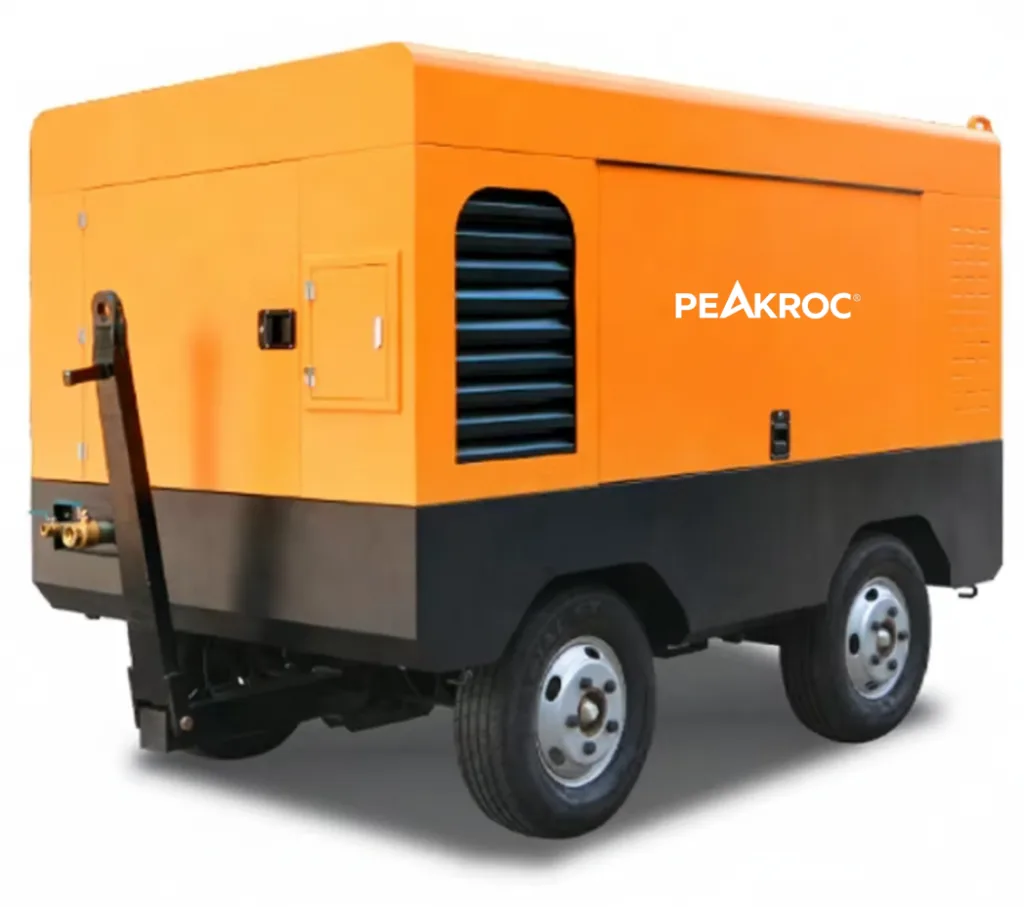
Flow Rate — Clearing the Hole
Airflow removes cuttings and maintains uphole velocity. Insufficient airflow leads to regrinding, reduced penetration, and stuck tools.
Flow demand correlates with hole diameter.
| Hole Diameter | DTH Hammer | Recommended Airflow |
|---|---|---|
| 3.5″ – 4.5″ | 3″ – 4″ | 500 – 900 CFM |
| 4.5″ – 6.0″ | 4″ – 5″ | 900 – 1300 CFM |
| 6.0″ – 8.0″ | 6″ – 8″ | 1300 – 2000 CFM |
Common Sizing Mistakes
From field audits, these errors are frequent:
- Ignoring altitude derating
- Not accounting for pipe pressure loss
- Running multiple rigs on one compressor
- Selecting based on price rather than drilling parameters
3. Part Two — Selection: Five Features That Define Quarry-Grade Compressors
Quarries present harsh operating environments — dust, vibration, heat, and continuous duty cycles.
Standard construction compressors often fail prematurely.
Here are the five non-negotiables.
1. Robust Structural Design
Look for:
- Reinforced steel chassis
- Corrosion-resistant enclosures
- Heavy-duty axles
- Off-road trailer suspension
Durability directly affects uptime.
2. Reliable Powertrain
Engine reliability defines productivity.
Common quarry-grade engines include:
- Cummins
- Caterpillar
- Volvo Penta
Emission tiers (Tier 3 / Tier 4 Final) impact fuel economy and compliance.
The air end is equally critical. High-efficiency screw rotors reduce fuel consumption significantly.
3. Intelligent Control Systems
Modern portable air compressor systems use adaptive controllers to:
- Adjust engine speed to demand
- Reduce idle fuel burn
- Monitor faults remotely
Smart control translates into measurable operating savings.
4. Heavy-Duty Filtration
Dust is the primary enemy in quarry environments.
Key requirements:
- Two-stage air intake filtration
- High-efficiency oil separation
- Replaceable safety filters
Clean air protects the compressor and downstream tools.
5. Service Accessibility
Maintenance downtime is costly.
Look for:
- Large service doors
- Ground-level filters
- Centralized drain points
Ease of service directly impacts ROI.
4. Part Three — Efficiency: Maximizing Return on Investment
Fuel represents the largest operating cost in diesel compressors.
Proper sizing and load control can reduce fuel burn by 15–30%.
Preventive Maintenance Planning
A structured schedule improves reliability.
Daily
- Check oil levels
- Inspect filters
- Drain condensate
500 Hours
- Replace oil filters
- Inspect belts
2000 Hours
- Change lubricants
- Inspect air end
Using OEM parts ensures design performance.
Operator Training
Improper operation causes avoidable failures.
Training should cover:
- Start-up procedures
- Load management
- Alarm diagnostics
Field Case Insight
One quarry client replaced oversized legacy units with correctly sized compressors.
Annual fuel savings exceeded $20,000 while improving drilling speed.
5. Peakroc® Quarry Compressor Solutions
At Peakroc®, we engineer compressor systems specifically for mining and construction drilling environments.
Our solutions integrate:
- High-pressure portable air compressor platforms up to 35 bar
- Cummins-powered diesel systems
- Heavy-duty dust filtration
- Intelligent load control
We also supply and service global brands such as Atlas Copco air compressor fleets, supporting mixed-equipment quarries.
6. Application Scenarios
Quarry compressors extend beyond blast hole drilling.
Mining
- DTH drilling
- Exploration drilling
- Bench blasting
Construction
- Foundation piling
- Slope stabilization
- Road drilling
Additional Uses
- Pipeline pressure testing
- Sandblasting
- Water well drilling
A correctly sized compressor becomes a multi-application asset.
7. Conclusion — Powering Quarry Productivity
Efficient quarry operations begin with three fundamentals:
- Scientific compressor sizing
- Quarry-grade equipment selection
- Continuous efficiency optimization
An air compressor is not an accessory — it is a productivity engine.
If you are evaluating upgrades or planning new drilling capacity, aligning compressor specifications with drilling parameters is the most cost-effective performance decision you can make.
Speak With Our Engineers
Have questions about pressure, airflow, or drilling depth?
Contact Peakroc® compressed air specialists for tailored recommendations.
Or explore our quarry-optimized portable air compressor range to see how the right system can transform your drilling efficiency.
Author

Mark Chen – Senior Mechanical Engineer, Peakroc®
Mark Chen is a senior mechanical engineer at Peakroc®, specializing in compressed air systems and drilling equipment for mining and construction applications. With over 15 years of field experience, he has led multiple projects on optimizing air delivery efficiency, equipment durability, and energy consumption.