
Industry Background: Why Compressor Matching Determines Blast Efficiency
In surface mining and large-scale quarry operations, blast hole drilling is often viewed as a rig-centric process. In reality, drilling productivity is just as dependent on the air supply system as it is on the drill rig itself.
Over the past decade, we’ve seen a clear shift toward deeper benches, harder rock formations, and larger hole diameters. These changes place significantly higher demand on compressed air systems — particularly when operating Down-The-Hole (DTH) drilling rigs.
A mismatch between the DTH hammer and the air compressor typically leads to:
- Reduced penetration rate
- Poor cuttings evacuation
- Excessive fuel consumption
- Premature hammer wear
- Hole deviation in fractured formations
From an engineering standpoint, blast hole performance is governed by air pressure stability + air volume delivery — not just rig torque or feed force.
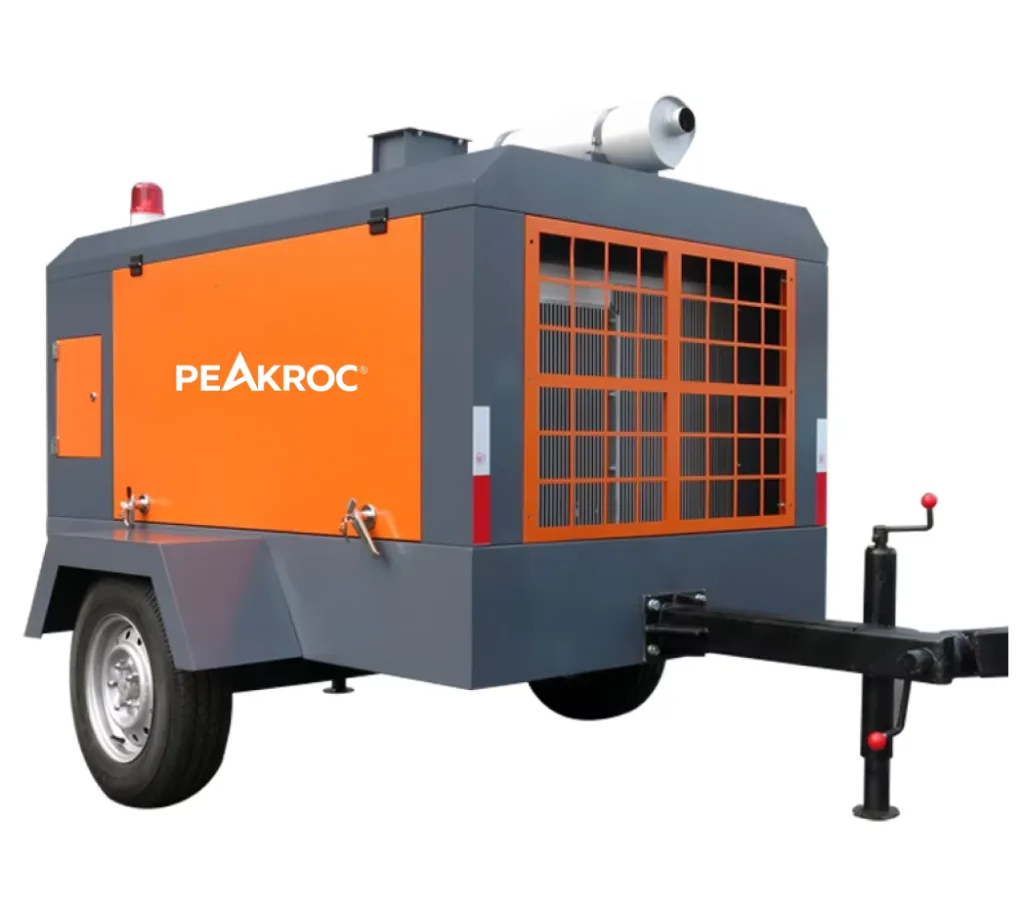
This is where properly configured portable air compressor systems become critical in mining and construction drilling environments.
Technical Principle: How Air Pressure Drives DTH Drilling Performance
Unlike top hammer drilling, DTH systems rely on compressed air to perform three simultaneous functions:
- Hammer actuation — driving the piston that impacts the bit
- Cuttings removal — flushing rock debris from the hole
- Hole stabilization — preventing collapse in fractured zones
As hole depth increases, air pressure losses occur due to:
- Friction along drill pipes
- Air leakage at joints
- Increasing hydrostatic pressure (in wet holes)
This means compressor output must increase proportionally with depth.
Typical Pressure & Airflow Requirements
| Hole Depth | Recommended Pressure | Air Capacity Range |
|---|---|---|
| 0–30 m | 7–10 bar | 10–16 m³/min |
| 30–60 m | 10–13 bar | 16–24 m³/min |
| 60–100 m | 13–18 bar | 20–30 m³/min |
| 100 m+ | 18–25 bar | 30–40+ m³/min |
Higher pressure ensures sufficient impact force at depth, while higher airflow maintains debris evacuation speed.
This is why deep blast hole drilling often requires high-pressure systems comparable to those used in water well drilling operations.
Engineering Matching: DTH Hammer vs Air Compressor
A correct match involves three parameters:
1. Hammer Size vs Air Volume
| Hammer Size | Hole Diameter | Air Consumption |
|---|---|---|
| 3″ DTH | 90–115 mm | 10–14 m³/min |
| 4″ DTH | 115–140 mm | 14–20 m³/min |
| 5″ DTH | 140–165 mm | 18–24 m³/min |
| 6″ DTH | 165–203 mm | 22–30 m³/min |
Undersized compressors reduce hammer impact frequency, lowering drilling speed.
2. Pressure vs Rock Hardness
- Soft limestone → 8–10 bar sufficient
- Granite / basalt → 16–25 bar required
- Quartzite / iron ore → 20+ bar recommended
Higher pressure improves bit button penetration and reduces energy loss.
3. Depth vs Pressure Compensation
Every additional 10 m of hole depth requires approximately 0.3–0.5 bar compensation to maintain hammer efficiency.
Without this adjustment, penetration rate drops exponentially.
Peakroc® Compressor + DTH Rig Integrated Solutions
At Peakroc®, we approach blast hole drilling as a complete air-drilling system — not separate equipment packages.
Our compressor systems are engineered specifically for DTH drilling rigs operating in mining and construction environments.
Key Engineering Advantages
1. High-Pressure Stability
PRMD Series compressors deliver up to 35 bar with minimal fluctuation (±0.2 bar), ensuring consistent hammer impact.
2. Optimized Air End Efficiency
Advanced screw profiles reduce energy loss at high pressure — critical for deep bench drilling.
3. Heavy-Duty Filtration
Two-stage intake filtration protects compressors in high-dust mining zones.
4. Fuel Optimization
Intelligent load control reduces diesel consumption during rod changes and idle cycles.
Brand Integration Capability
In addition to our own systems, Peakroc® supplies and services global compressor brands including:
- atlas copco air compressor systems (XAS / XAVS / XATS series)
- Sullair portable compressors
- Ingersoll Rand / Gardner Denver units
- Kaishan & Liutech drilling compressors
This allows mining contractors to maintain mixed fleets with unified service support.
Application Scenarios
Mining & Quarrying
Primary blast hole drilling for:
- Iron ore
- Gold mines
- Copper deposits
- Limestone quarries
High-pressure compressors improve hole straightness and blasting fragmentation.
Construction & Infrastructure
Used in:
- Foundation piling
- Slope stabilization
- Highway rock excavation
- Hydropower station drilling
Portable systems enable flexible site relocation.
Water Well & Geothermal Drilling
Deep borehole air drilling shares similar compressor requirements:
- 18–25 bar pressure
- High flushing velocity
- Moisture resistance
This crossover makes high-pressure compressors versatile assets across drilling sectors.
Industrial & Laser Cutting Support
While primarily drilling-focused, portable compressors also support:
- Sandblasting
- Pipeline testing
- Backup air supply
- Laser cutting nitrogen/air assist systems
Field Selection Guide
When selecting a compressor for blast hole drilling, engineers should evaluate:
- Target hole diameter
- Bench depth
- Rock hardness index
- Hammer model
- Altitude (air density impact)
A safety margin of 20–30% airflow reserve is recommended for stable operation.
Conclusion: Air Power Defines Drilling Performance
Blast hole drilling efficiency is not determined by rig power alone. The air compressor dictates hammer force, cuttings removal speed, and ultimately cost per meter drilled.
From shallow quarry benches to deep mining blast holes, correctly matched high-pressure portable compressors deliver:
- Faster penetration
- Lower fuel cost per meter
- Extended hammer life
- Cleaner hole conditions
At Peakroc®, we engineer integrated compressor + DTH rig solutions tailored to real field geology — not theoretical specifications.
If you’re planning a blast hole drilling project, our engineering team can recommend the correct air pressure and airflow configuration based on your drilling depth and formation profile.
Author

Mark Chen – Senior Mechanical Engineer, Peakroc®
Mark Chen is a senior mechanical engineer at Peakroc®, specializing in compressed air systems and drilling equipment for mining and construction applications. With over 15 years of field experience, he has led multiple projects on optimizing air delivery efficiency, equipment durability, and energy consumption.