
Key Takeaways
- A 185 CFM (≈5.2 m³/min) at 7 bar portable air compressor is widely used for jack hammers, light pneumatic tools, and auxiliary drilling operations.
- At 7 bar, this class of compressor is best suited for surface construction, shallow rock breaking, trenching, and light quarry work, not high-pressure DTH drilling.
- Stable airflow, moisture control, and engine–compressor matching determine tool life and impact efficiency.
- In integrated drilling ecosystems (DTH rigs, Top Hammer rigs, Water Well rigs), compressor selection must match geological conditions and tool load—not just price.
- Peakroc® engineering data shows that correct airflow matching can improve pneumatic tool efficiency by 50%.
What Is a 185 CFM 7 Bar Portable Air Compressor Used For?
A 185 CFM portable air compressor delivering 7 bar (approximately 100 psi) is commonly deployed for:
- Jack hammers (pneumatic breakers)
- Light rock drills
- Surface roadwork
- Pipeline trenching
- Small quarry applications
- Auxiliary support in mining sites
In field operations, this size is considered the entry-level industrial standard for mobile compressed air systems.
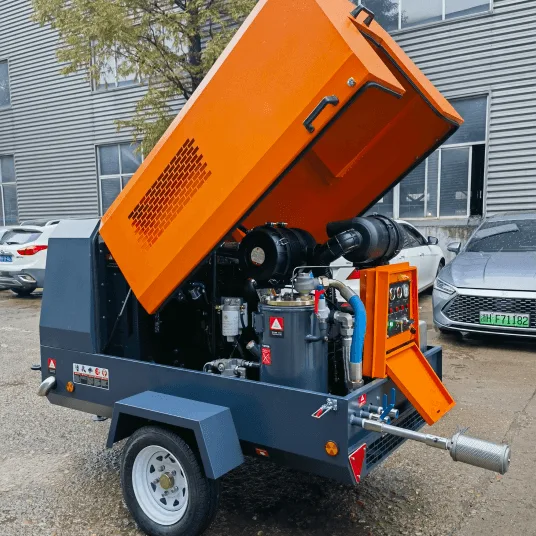
How Does a 185 CFM Portable Compressor Work?
A modern Peakroc® portable compressor in this class typically features:
- Diesel engine drive system
- Oil-injected rotary screw air end
- Aftercooler & moisture separation
- Pressure regulation system
Working Principle
- Air is drawn into the screw air end.
- Twin rotors compress the air internally.
- Oil injection cools and seals during compression.
- Air-oil separation system removes lubricating oil.
- Regulated 7 bar air is delivered to the tool.
Unlike piston compressors, rotary screw systems provide:
- Continuous airflow
- Reduced pulsation
- Lower vibration
- Higher durability under jobsite conditions
Why 185 CFM at 7 Bar Is Ideal for Jack Hammers
A standard pneumatic jack hammer typically requires:
- 90–100 psi operating pressure
- 3–5 m³/min airflow depending on tool size
With 185 CFM (~5.2 m³/min), operators can:
- Power one heavy-duty breaker
- Run two medium tools simultaneously
- Maintain stable impact force
Field observations indicate that insufficient airflow results in:
- Reduced striking energy
- Tool overheating
- Increased wear on internal valves
Is a 7 Bar Compressor Suitable for DTH Drilling?
Short answer: Not for high-pressure DTH drilling.
Why?
DTH drilling rigs typically require:
- 18–30 bar operating pressure
- High airflow volume
| Application | Required Pressure | Airflow Demand |
|---|---|---|
| Jack hammer | 6–7 bar | Moderate |
| Top hammer drilling rig | 8–10 bar | Moderate |
| DTH drilling rig | 18–30 bar | High |
A 7 bar compressor is suitable for:
- Auxiliary site work
- Top hammer pilot drilling
- Small-diameter shallow boreholes
But not for deep blast-hole drilling.
How Does This Compressor Fit Into the Peakroc® Ecosystem?
Peakroc® does not treat air compressors as standalone machines. They are part of a broader drilling solution that includes:
Drilling Rigs
- Integrated DTH drilling rigs
- Separated DTH drilling rigs
- Top hammer drilling rigs
- Water well drilling rigs (crawler / truck / portable)
Drilling Tools
- DTH hammers & bits
- Top hammer rods & adapters
- Drill pipes & couplings
Precision Detection
- ADMT ultra-speedy mineral detectors
- Water detection systems
- Water level survey tools
Compressor selection must align with the intended drilling method.
How Geological Conditions Influence Compressor Choice
This is where many buyers focus too heavily on “cheap price.”
A compressor must match:
- Rock hardness
- Tool diameter
- Drilling depth
- Ambient temperature
- Altitude
For example:
- Cobble or fractured zones require steady airflow
- Limestone demands stable pressure
- Basalt requires high-pressure DTH systems
Without proper matching:
- Tool wear increases
- Fuel consumption rises
- Penetration rate drops
What Should You Look for in a 185 CFM Portable Compressor?
- Engine brand & fuel efficiency
- Air end reliability
- Oil separator efficiency
- Noise reduction system
- After-sales service network
Cheap price should not compromise:
- Rotor precision
- Cooling capacity
- Air filtration quality
Cost vs Performance – A Practical Comparison
| Factor | Low-Cost Generic | Peakroc® Engineered Unit |
|---|---|---|
| Initial Price | Lower | Competitive |
| Fuel Efficiency | Variable | Optimized |
| Air Stability | Inconsistent | Calibrated |
| Tool Wear | Higher | Reduced |
| Lifecycle Cost | Higher | Lower |
Frequently Asked Questions
Can 185 CFM run two jack hammers at once?
Yes, depending on tool size and air demand, but airflow stability must be maintained.
Is 7 bar enough for water well drilling?
For shallow soft formations, possibly. Hard rock requires DTH systems at higher pressure.
Does compressor size affect drilling accuracy?
Indirectly, yes. Inconsistent pressure causes unstable impact energy, affecting borehole quality.
Contact Peakroc®
Peakroc® Drilling Machinery delivers complete drilling ecosystems:
- Portable air compressors
- Integrated & separated DTH drilling rigs
- Top hammer rigs
- Water well series
- Drilling tools & consumables
- ADMT ultra-speedy geological detectors
Contact Peakroc® Engineering Team to align airflow, geology, and productivity.
Author

Mark Chen – Senior Mechanical Engineer, Peakroc®
Mark Chen is a senior mechanical engineer at Peakroc®, specializing in compressed air systems and drilling equipment for mining and construction applications. With over 15 years of field experience, he has led multiple projects on optimizing air delivery efficiency, equipment durability, and energy consumption.